“I come to praise and bless Thee…persuaded that…Thou wilt know how to take better care than I could do of my dearest interests; I want only to think of Thee, knowing that Thou wilt think of me…to put into practice the ‘one thing necessary,’ to lay aside all our cares…so as to occupy ourselves…with Him alone…”
~Blessed Columba Marmion, OSB, abridged quote
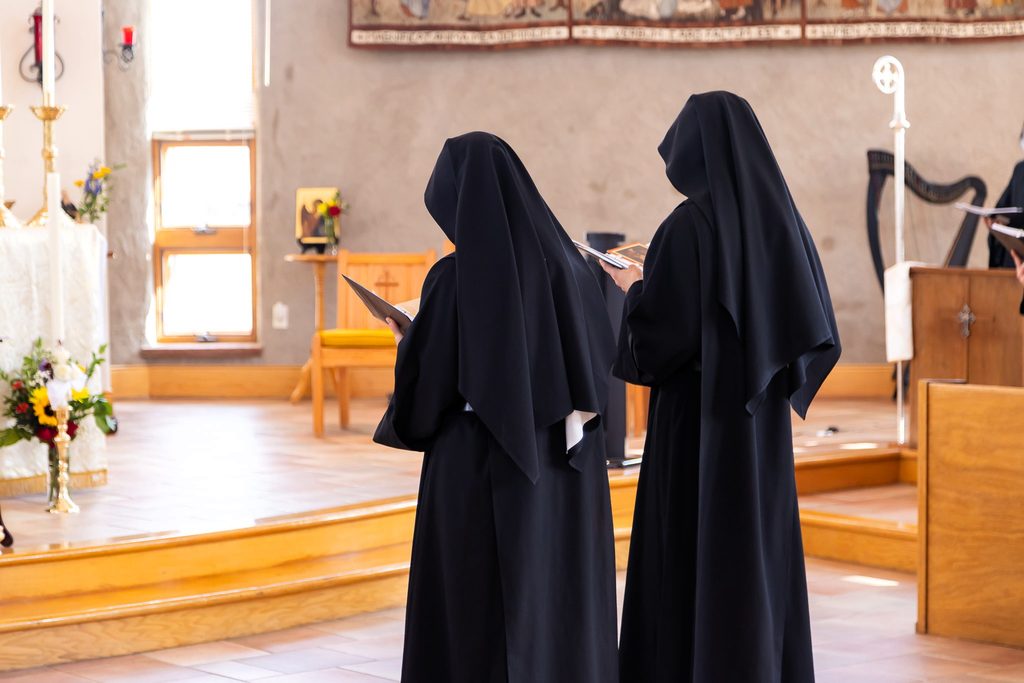
Photo by André Escaleira, Jr. / Denver Catholic
Overview
As Benedictines, a primary focus of our lives is to glorify God through praying the “Opus Dei” (“Work of God” in Latin), as designated by St. Benedict in his Holy Rule for monks, legislated in the 6th century. This form of communal liturgical prayer is more commonly known today as the “Divine Office,” or “Liturgy of the Hours.” If the Eucharist is the source and summit of our faith, then the Divine Office is our constant return to that source throughout the day, in order to drink again and again from that Holy Fountain, as we return to the summit of that Holy Mountain to pray. Christ is the Living Water and Solid Rock to whom we return when we pray the Divine Office.
As our Sister Genevieve Glen, OSB, wrote in her book The Word in Time, “Drawing from centuries of experience, the Church’s present-day General Instruction of the Liturgy of the Hours (GILH) claims that the liturgical Hours have a profound time-related goal that far transcends the vision of the consumer mindset with its thirst for tangible negotiable profit: ancient Christian tradition holds specifically that ‘the purpose of the liturgy of the hours is to sanctify the day and the whole range of human activity’ (GILH 11)…As I wrestled with the question of how time could be sanctified, I realized that it is not the abstraction we designate as ‘time’ that can be made holy—rooted in God—but our stories as we live them in time. The question then becomes: ‘How does praying the Hours foster the changes necessary to make our own lives holy?’…Essentially, as we immerse ourselves in God’s word and Christ the Word repeatedly throughout the day, every day, to whatever extent we can, we are drawn more and more deeply into Christ’s paschal story…As return to facets of it [Christ’s life revealed through the psalms] again and again in the Hours, we find ourselves invited to reflect on and perhaps redirect our own daily story” (The Word in Time, p. 10-18, abridged).
It is a noble ideal for all Christians to pray a portion of the Divine Office as they are able, but it is specifically required of priests and religious (nuns, monks, sisters, brothers) who are bound by their vows to pray the Opus Dei daily. By stopping whatever we are doing when the Office bell rings, we are responding with haste to the voice of the Lord calling us to return to Him. This is the call of the Benedictine: constant returning to the Source of our being—to thank Him, praise Him, implore Him, pour out our hearts to Him, bring the sufferings of the world to Him. The psalms help us to do this. In the psalms, we find a range of human experiences and emotions. From the jubilation and dancing of King David, to the agony of Psalm 22 (containing the words Our Lord prayed as He hung on the cross: God, my God, why have You forsaken me…), there is a song for every season within this book of prayer. We may not be feeling particularly jubilant or sorrowful as we are called to pray the words put before our eyes, but since we are praying as a member of the Church, Christ’s Body, it’s not just about where we are in our spiritual journey—As we pray, we are in a spiritual sense taking on the sorrowing of some suffering member of the Church, or the joy of a rejoicing member, instead of limiting ourselves to our current state of mind.
As Sr. Genevieve so beautifully reflected in The Word in Time, “Whether we celebrate the Hours in community or alone, praying the Hours is always intensely personal. The psalms and canticles often put the words ‘I,’ ‘me,’ ‘my,’ and ‘mine’ on our lips, inviting us to read them as expressions of our own hearts. And so they are…However, because the Hours are liturgical prayer, every ‘I’ has a wider reach than my own individual self…The General Instruction distinguishes between personal feelings in private prayer and sentiments expressed in psalms when praying in the name of the Church. The distinction addresses questions that may sometimes plague us when we pray: How can I sincerely pray, ‘Have mercy on my, Lord, for I languish. / Lord, heal me; my bones are shaking, / and my soul is greatly shaken. / … I am exhausted with my groaning; / every night I drench my bed with tears, / I bedew my couch with weeping. / My eyes waste away with grief’ (Ps 6:3-4, 7-8) when I have just received the happy news of the birth in the family or a much-desired promotion at work? Or how can I pray, ‘my heart rejoices, my soul is glad” (Ps 16:9) when I have just watched a news account of thousands killed in an earthquake somewhere overseas?… We must open our awareness to the experiences of a world beyond our own private circle and pray on others’ behalf…In joy or in sorrow, fear or gladness, we give voice to those who have no voice, to those who are not present…We pray the biblical texts on behalf of those who have no words because they have been deafened and rendered mute by unbearable circumstances surrounding them…Quite a responsibility we seek to carry out, even with all our limitations! The only response we can really make as we recognize the magnitude of the responsibility God lays upon our small shoulders is, ‘Let us pray!’ (The Word in Time, p. 36-40, abridged).
“Receive the Divine Office of the Church.
Prefer nothing to the work of God,
and together with your Sisters,
bring praise to God the Creator.
What you sing with your lips, believe in your heart;
what you believe in your heart, carry out in your life.”
~Prayer of the Presider of the Solemn Monastic Profession,
upon handing the Professed Nun her Divine Office book
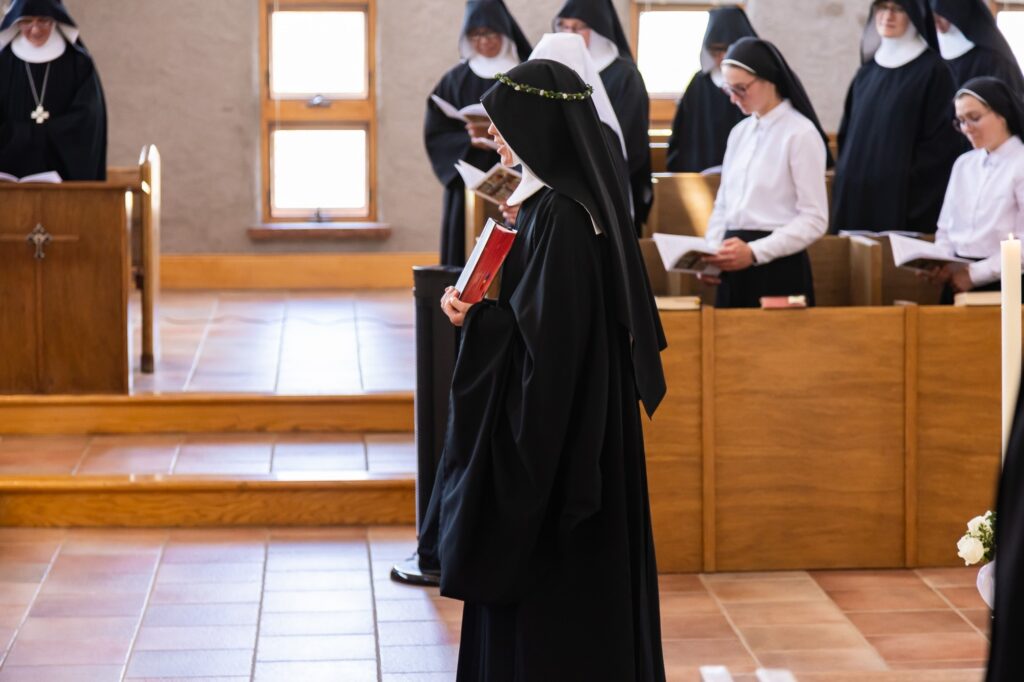
Photo by André Escaleira, Jr. / Denver Catholic
History
St. Benedict ordered the Opus Dei of his communities so that in the course of a week they would pray the entire Book of Psalms. He expresses that this is really the least they could do, considering the fact that the desert monks prayed the entire Psalter every day! From this we gather that the Benedictine tradition of praying the psalms at fixed hours of the day had its roots in the practice of the desert monks, who lived in the Egyptian desert in the 4th century. However, the desert monks’ practice of praying the Psalter goes back even further, to a tradition borrowed from Judaism. The Jews historically recited prayers daily in their homes, which included the psalms; and they also made pilgrimage to the Temple in Jerusalem at least three times a year, where chanting of the psalms (most likely by the Levites) was performed as part of the public worship. The Apostles of Christ observed the Jewish custom of praying the psalms and reading from the Old Testament, and even going to the Temple for the fixed hours, as we read in the New Testament (cf. Acts 10:3, 9; 16:25). At some point, the Christians started including readings from the Gospels, Epistles of St. Paul, canticles, and additional prayers; and throughout the course of the 5th century, there emerged the following standard prayer hours of the Divine Office: Vigils, Matins, Lauds, Prime, Terce, Sext, None, Vespers, and Compline (click here to see our liturgy schedule, which includes nearly this exact program of liturgical prayer).
The Divine Office at the Abbey of St. Walburga
Practically speaking, we gather together in our Church seven times a day to pray an “hour.” However, each hour of prayer is not actually an hour long; rather, the term “hour” refers to being prayed at a specific hour of the day. The hours include: Matins (Office of Readings), Lauds (Morning Prayer), Terce (Midmorning Prayer), Sext (Midday Prayer), None (Midafternoon Prayer), Vespers (Evening Prayer), and Compline (Night Prayer).
The basic structure of the Divine Office Hours is:
-Opening hymn
-Antiphons and psalms
-Scripture reading
-Responsory
-Collect/Closing prayer
-Variations: During Matins we have two longer readings, one from Scripture, and one from (mainly) Patristic sources/writings of the Church Fathers. During Lauds, we pray the Benedictus and also include a short list of intercessory prayers. During Vespers, we pray the Magnificat and also include intercessory prayers. For the various liturgical seasons of the year (Advent, Christmas, Lent, Easter), there are Offices specific to those seasons. We also have special offices for feast days of saints.
Our particular version of the Divine Office is unique to our community, because it is not the Roman Office, but the Monastic Office, and was created from the rubrics given by the Church for Benedictines. However, for anyone who is interested, there are standard editions of the Roman Office available to everyone in online and print versions (see resources below).
In case you are curious why we stand, bow, and sit at the end of every psalm, St. Benedict in his Holy Rule instructs his monks to bow whenever the Doxology is said (i.e., whenever we honor the names of the Father, Son, and Holy Spirit). That is why we bow when the Names of the Holy Trinity are on our lips, but rise after we have finished saying “Holy Spirit.”
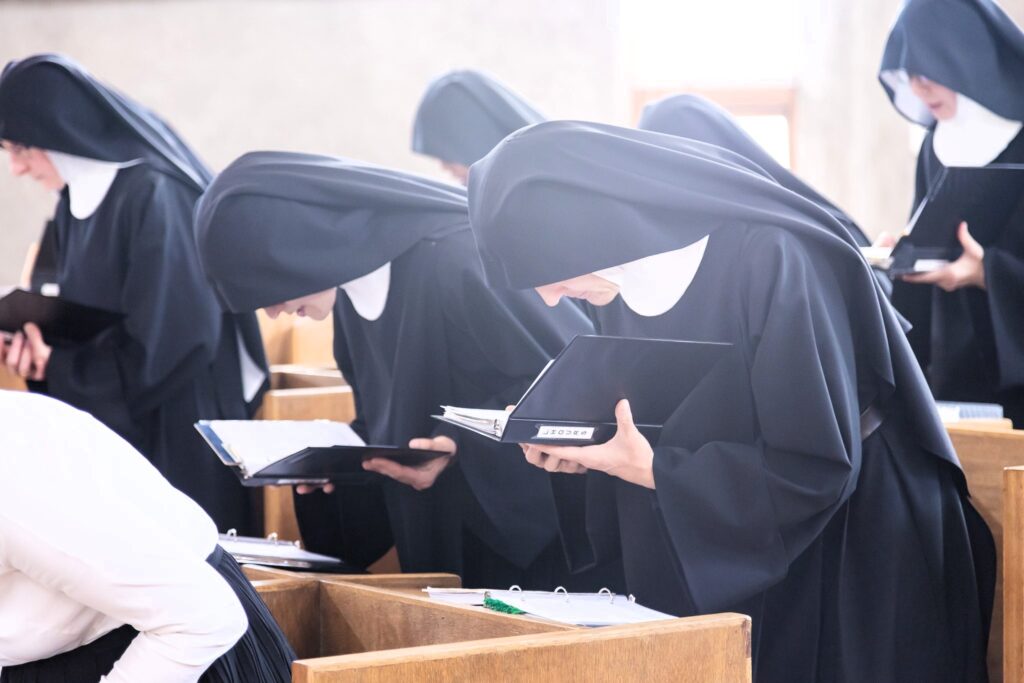
Photo by André Escaleira, Jr. / Denver Catholic
Online Resources:
United States Conference of Catholic Bishops: Liturgy of the Hours
Options for praying the Liturgy of the Hours:
Pray Today’s Office Online: Online Version of the Roman Divine Office
Pray Today’s Office with Hallow: About the Liturgy of the Hours/Pray with Hallow
Subscribe to Word on Fire’s Monthly Booklets (Morning, Evening, and Night Prayer for each day of the month; $8.25/month billed annually): The Liturgy of the Hours
Word on Fire’s Second-Edition Four-Volume Set (Complete Liturgy of the Hours; released in 2027): New Four-Volume Set
Ascension Press’ Second-Edition Four-Volume Set (Complete Liturgy of the Hours; released in 2027): New Four-Volume Set
Four-Volume Set (Complete Liturgy of the Hours; older version): First-Edition Four-Volume Set (From Catholic Supply) First-Edition Four-Volume Set (From The Catholic Company)
Traditional Monastic Diurnal (This monastic breviary contains the Benedictine hours of Prime, Lauds, Terce, Sext, None, Vespers and Compline, in Latin (vulgate) and English in parallel columns for all the feasts and seasons in the traditional Benedictine calendar)
Recommended Books:
A Layman’s Guide to the Liturgy of the Hours by Fr. Timothy Gallagher
Praying the Liturgy of the Hours: A Personal Journey by Fr. Timothy Gallagher
The Word in Time by Sr. Genevieve Glen, OSB