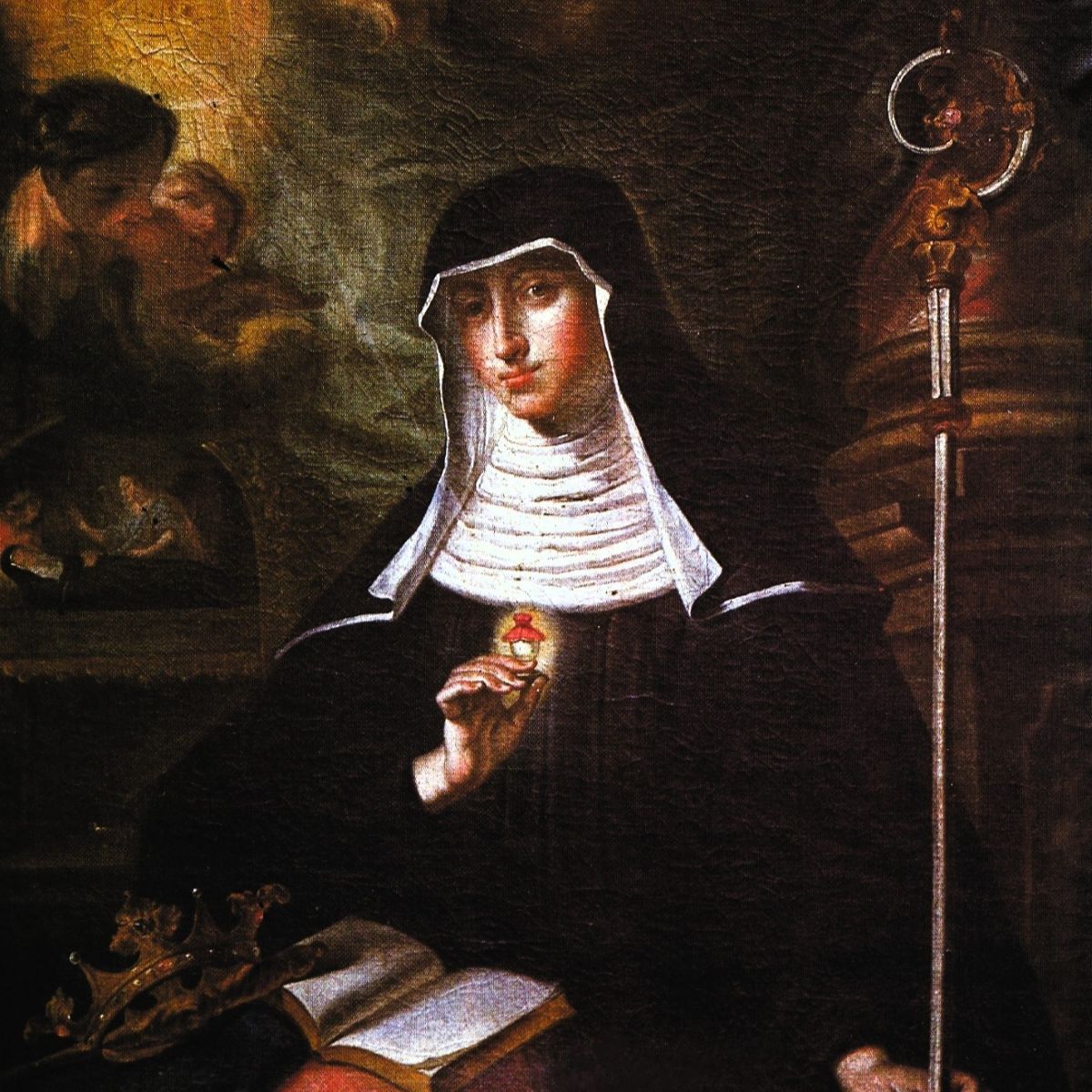
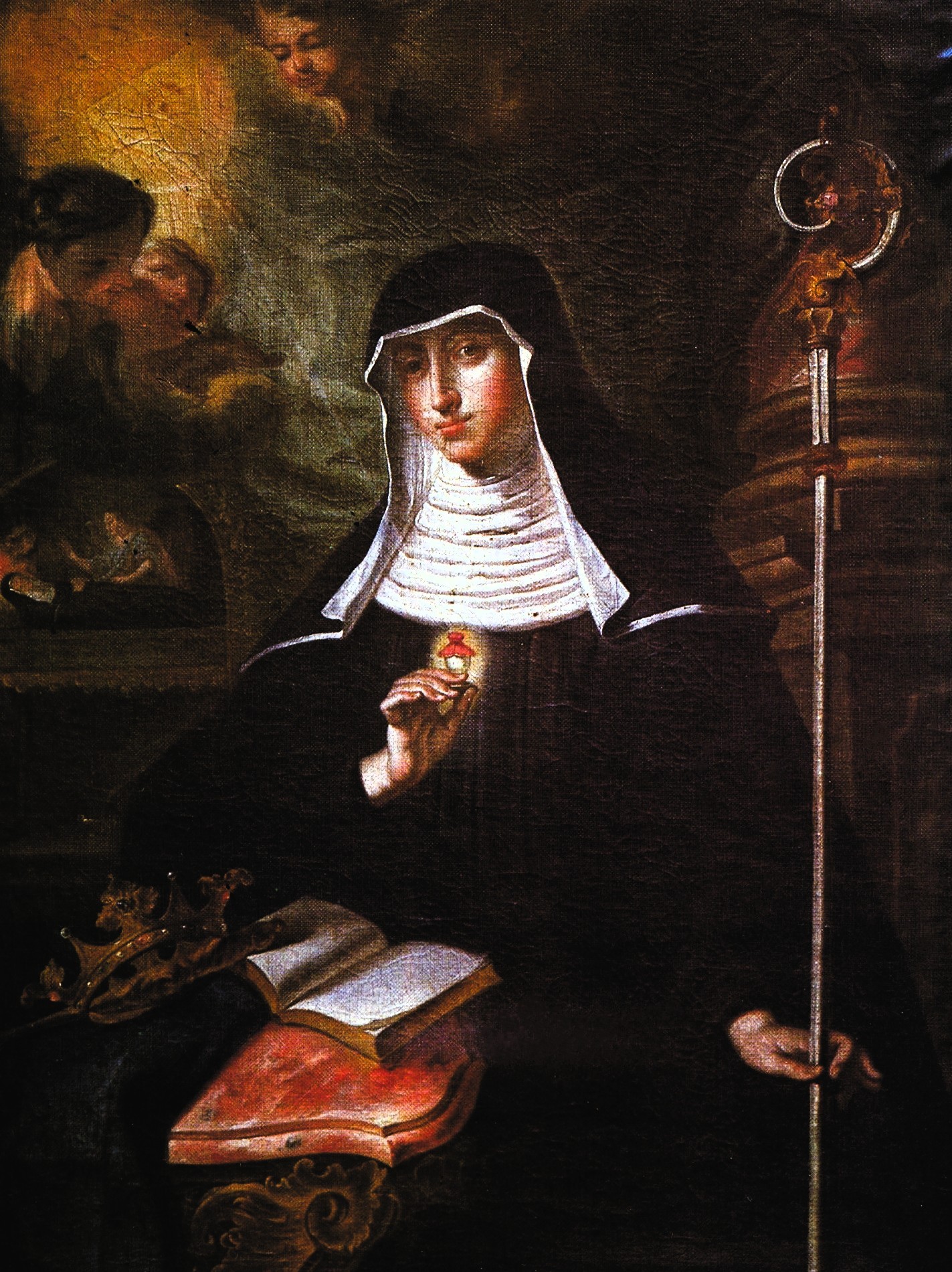
18th century painting of St. Walburga by an unknown artist, currently found at the Abtei of St. Walburg in Eichstätt
St. Walburga was born in what is today known as the county of Wessex in southern England in 710, into a noble family of saints. Her father was St. Richard, and her mother was Wuna, the sister or cousin of St. Boniface. Her two brothers, St. Willibald and St. Wunibald, also became saints.
As a child around the age of 10, St. Walburga was entrusted to the care of the Benedictine nuns of Wimbourne Abbey in present-day Dorset, England. For about 28 years, St. Walburga lived the typical monastic life of singing the praises of God in the Divine Office and presumably performing ordinary tasks around her monastery. Between 740 and 750, when St. Boniface asked the superior of Wimbourne to send nuns to help him in his missionary efforts in Germany, St. Walburga and around thirty other nuns were appointed to make the journey across the English Channel.
It was at this time that we hear of St. Walburga’s first recorded miracle. While they were on the boat that carried them across the Atlantic Ocean, a terrible storm came, but through her intercession the storm ceased, and they were able to safely continue their voyage. It is reminiscent of Jesus calming the storm at sea, whereupon His disciples were all amazed and said, “What sort of man is this, whom even the winds and the sea obey?” (cf. Matt. 8:24-27). Moses, too, wielded authority over the waters when God gave him the power to part the Red Sea for the Israelites to cross over to safety from their Egyptian pursuers. From her miracles, one gets the sense that St. Walburga stands among the great men and women of the Old Testament, the powerful prophets of God. But the person she followed the most, of course, was Christ. It was in following His example—and by His authority—That she was able to accomplish such great wonders.
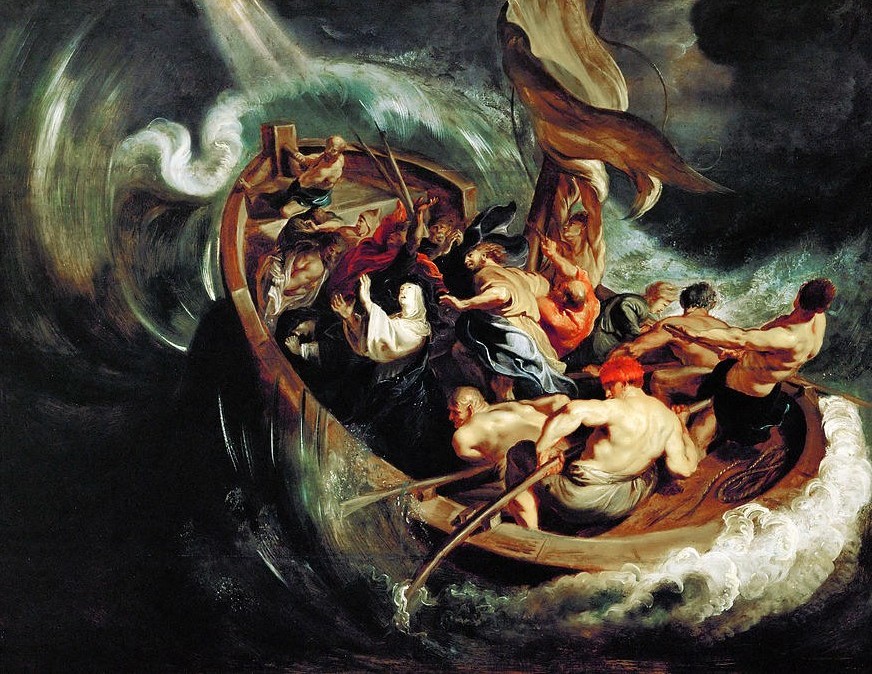
The Miracle of St. Walburga by Peter Paul Rubens, c. 1610, currently housed in a private collection
Upon the nuns’ arrival in Germany, they taught the young, cared for the sick, and helped the poor with alms. After two or three years, once the monastery at Heidenheim had been built by Wunibald, she traveled to join him and set up a monastery for nuns nearby. They prayed the Divine Office together, but were otherwise separate from the monks, forming a double monastery. When Wunibald died, Willibald named Walburga his successor, and she became Abbess over both monks and nuns of Heidenheim.
Another miracle of Christ that St. Walburga imaged was the healing of Jairus’ daughter. Jesus went to Jairus’ house and told the mourners that the girl was only sleeping, and brought her back to life by taking her hand, and saying, as one of the translations tells us, “Little Lamb, arise” (Talitha Koum). Then—and how Benedictine—He tells the onlookers to get her something to eat (cf. Mark 5:38-43). Similarly, it was recorded that St. Walburga went out at one night to the house of a nobleman, whose daughter was near death. The nobleman offered St. Walburga all the niceties, everything wonderful, as he bade her sit down with him, and by the time she was able to go upstairs to pray for the girl, the family had declared her dead. Regardless of this news, St. Walburga spent the night with the little girl in prayer, and when the sun arose, she presented a perfectly healthy girl to the noble parents, and then quickly returned to her monastery. The father tried to load her up with gifts to take back to her monastery, but she politely refused them and carried on without a fuss. There was no fanfare. She was simply a servant, a servant at work, who had completed her God-given task. That’s how you know the true humility of a saint: She’s not in it for the fanfare.
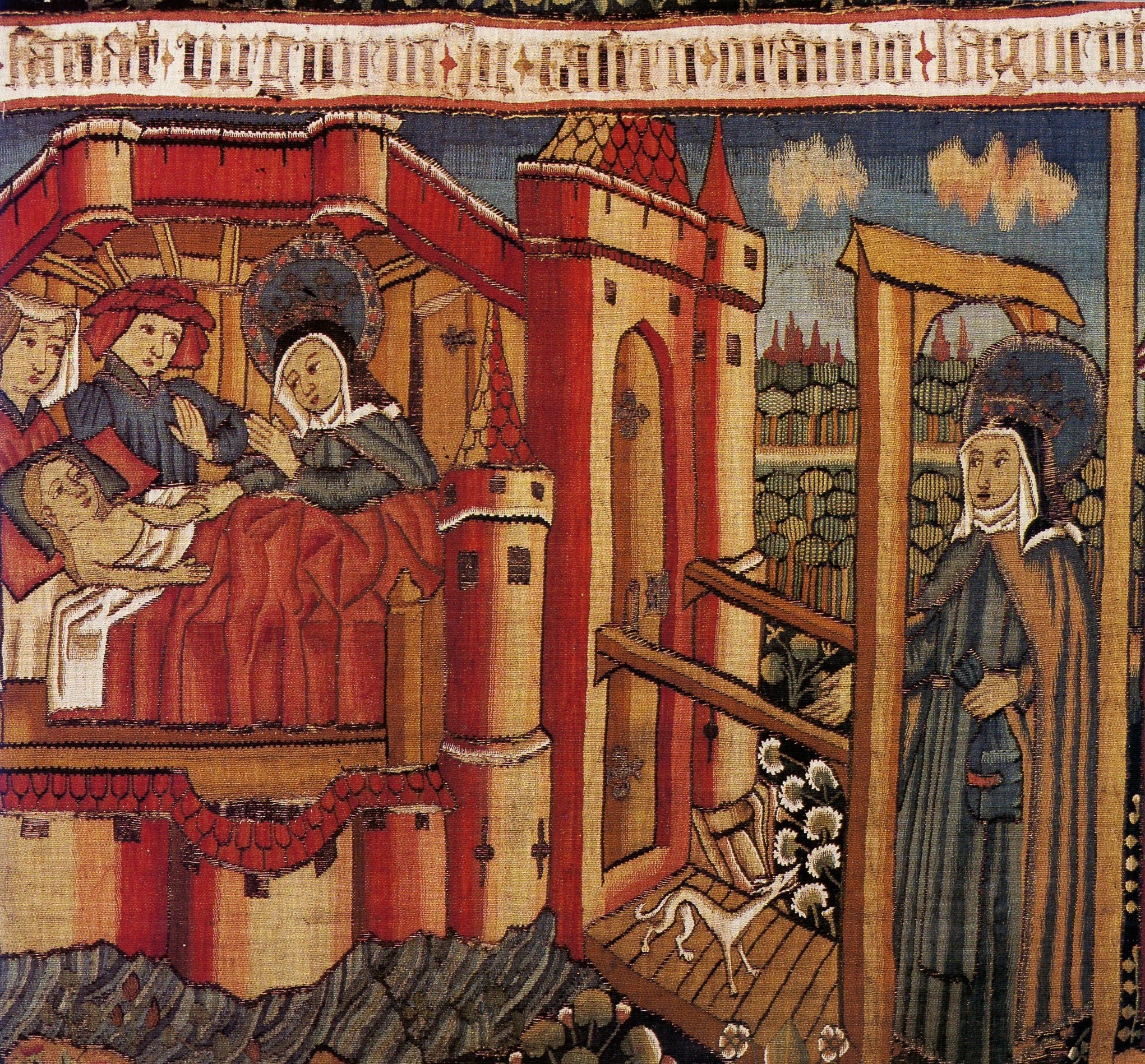
St. Walburga visits the sick girl / Tapestry artwork from the Abtei St. Walburg in Eichstätt, Germany
St. Walburga is known to be a saint of extraordinary light. On one occasion, she went into the monastery church at night, and she asked a monk (she was the Abbess of the double monastery of men and women at the time) for a torch to find her way, but the monk flatly refused. So instead, God lit the whole house up in abundance, in flowing light, which her nuns saw, and which seemed to “penetrate to the very heart of the earth.” St. Walburga, like another famous female Benedictine saint, St. Scholastica, asked a monk for a kindness, and was rejected — St. Scholastica had asked her brother, St. Benedict, to stay with her and pray shortly before she died, but he refused; then she turned to God and prayed, and a huge storm suddenly rolled in, which served to prevent St. Benedict from returning to his monastery, and he was forced to meet his sister’s request. When St. Walburga asked a monk for a light to see, and was refused, she too turned to God in prayer, and her request was answered with the miracle of light.
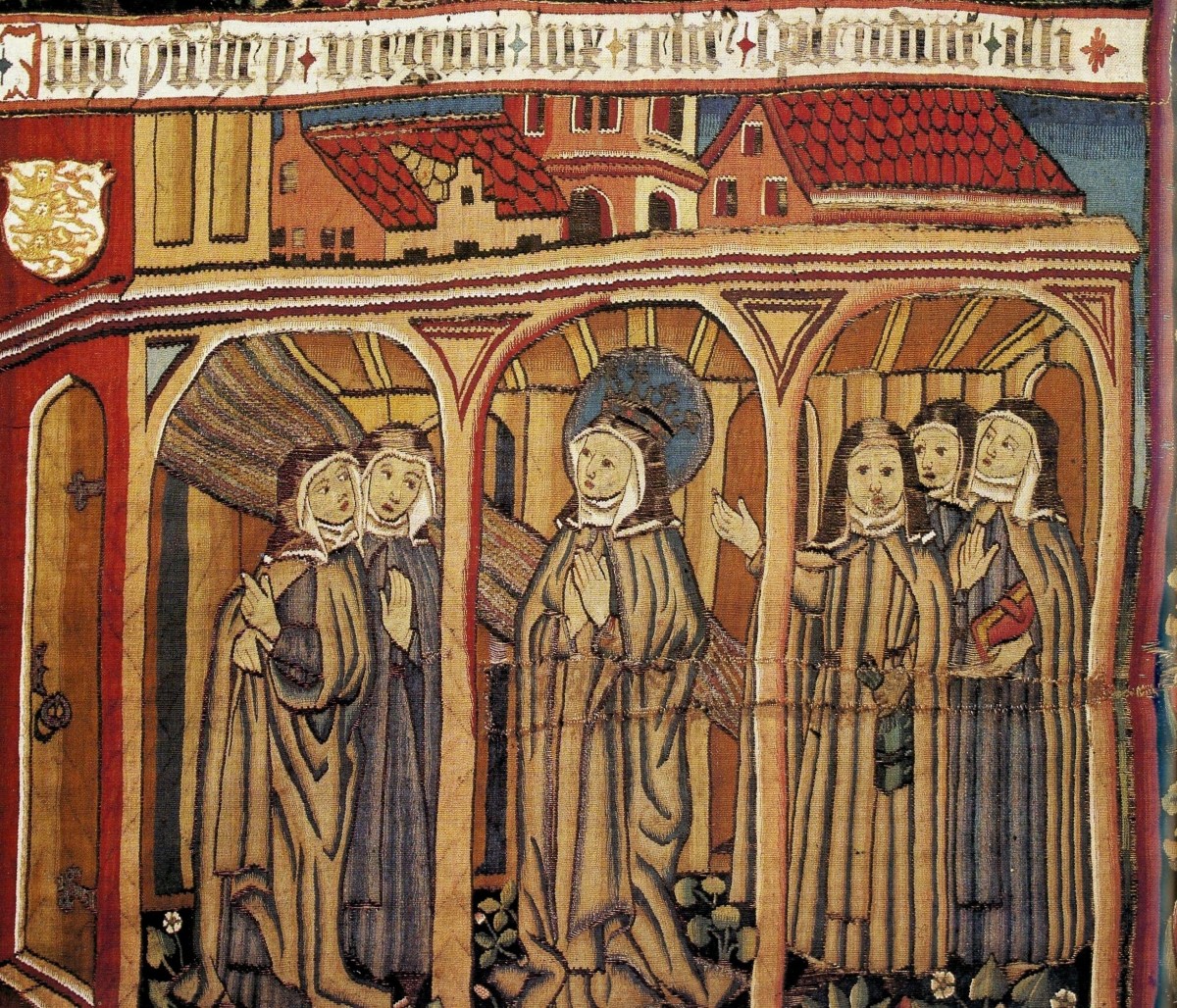
St. Walburga and the miracle of light / Tapestry artwork from the Abtei St. Walburg in Eichstätt, Germany
And then we also recognize the spirit of God acting freely and powerfully in St. Walburga through the miraculous holy oil that still flows from her bones. We hear in John 4:14, “Indeed the water I give them will become in them a spring of water welling up to eternal life,” and in Isaiah 8:11, “You shall be like a watered garden. Like a spring of water whose waters do not fade.” It seems that St. Walburga’s great compassion for others did not end at her death, but continues to be a pure gift of God which flows throughout the ages for the good of His Church. Many people write us asking for St. Walburga’s oil, and then take the time to share their stories of healing with us. One could say that this quote from St. Thérèse of Lisieux may also be applied to our patroness: “I wish to spend my heaven in doing good upon the earth.” St. Walburga certainly does.
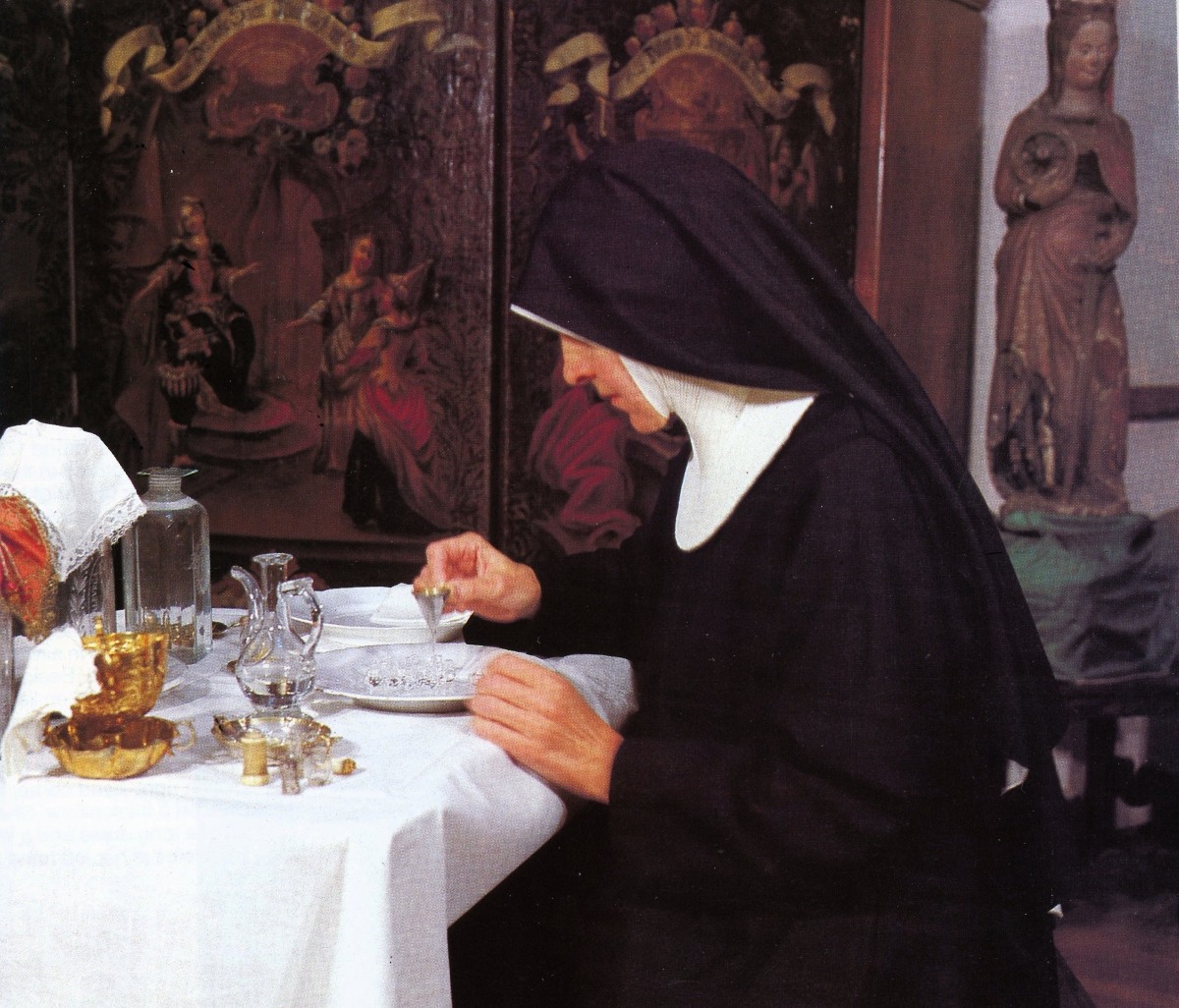
The bottling of St. Walburga’s Holy Oil at the Abtei St. Walburg in Eichstätt, Germany
When St. Walburga died around the year 779, she was buried at the monastery at Heidenheim, but the years went on, her name appeared to be forgotten, and her grave was no longer held in honor. The story of the discovery of her relics is quite amusing: In 842, when Bishop Otkar was undertaking renovation of the church at Heidenheim, St. Walburga appeared to him in a dream and complained, “Every day I am stomped on by [the workmen’s] dirty shoes, and am maltreated by their rough footsteps. Therefore, you should know that I will give you a clear sign that you have not acted justly against me” (Wolfhard, The Book of Miracles: Walburga as Abbess). Soon after this dream, the newly constructed northern wall of the church collapsed. The bishop saw this as the sign St. Walburga had warned him about, and arranged for her remains to be moved to the Cathedral in Eichstätt, to give her a worthier resting place next to her brother Willibald. “The men who were digging according to the request of the bishop found the venerable bones of…Walburga covered with some drops of spring water… Although the soil was moist, no residue of dirt could be observed at the hands of those who touched it” (Wolfhard). When the horses pulling the carriage with her relics stopped at the western gate of the city and refused to go any further, this was taken to be a sign that she wished to be buried in the nearby chapel that would later be called St. Walburga’s Church. Her body was reinterred in the chapel there, an act which marked the beginning of her public veneration, since at that time the transfer of relics was equivalent to an official act of canonization. A small community of canonesses became custodians of her shrine until her relics were moved to the Abtei of St. Walburg after its founding in 1035.
In 893, an Abbess from a neighboring monastery in Monheim requested some of St. Walburga’s relics. While on the way to Monheim, “two very sick boys who had independently of each other requested to touch the small case with the saint’s relics, were instantly healed from their infirmities in a miraculous way…The news spread far and wide. Everyone in Monheim rejoiced that the saint has brought such blessings to their town, while the population of Eichstätt, worrying that the saint might have abandoned them, had to be assured by the bishop that only a small part of her relics had been given away” (Wolfhard).
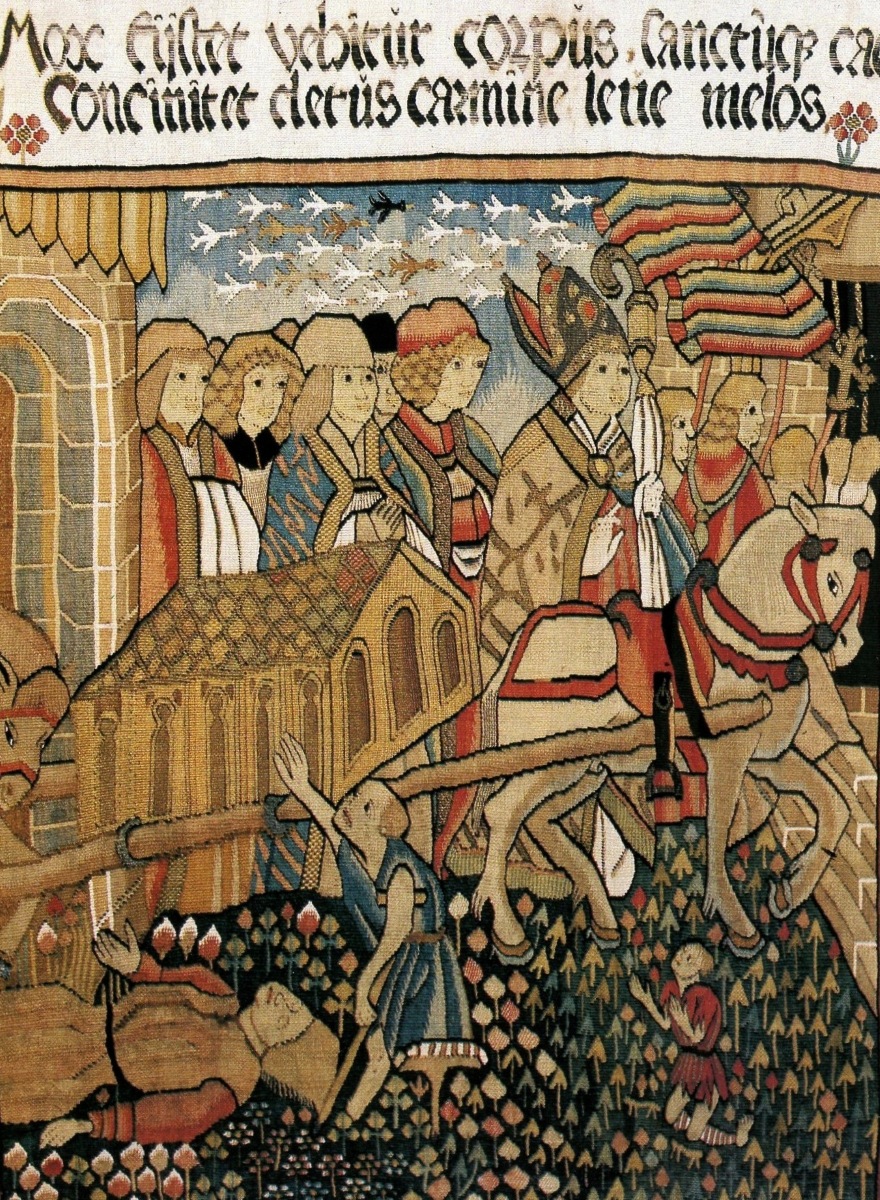
Art caption: St. Walburga’s bones are brought to Monheim / Tapestry artwork from Abtei St. Walburg in Eichstätt, Germany
“Pilgrims flocked from near and far…to St. Walburga’s shrine in Monheim. It was above all people from the lowest ranks of society, especially the poor, who were at the mercy of pestilence, infections, famine, and acts of violence. The pilgrims undertook long journeys. On arrival they repeatedly visited the shrine containing the relics of St. Walburga, took part in the Liturgy and Divine Office of the nuns, brought gifts with them, told the nuns of their illnesses and distress, and not infrequently witnessed extraordinary healings. The nuns kept a written record of these healings. Furthermore, a great number of votive offerings, such as crutches, candles, swords, effigies of body parts that were healed, and pictures which display the distress and Walburga’s help, give evidence of these miraculous events” (Wolfhard).
The Abtei of St. Walburg in Eichstätt, where the majority of St. Walburga’s bones remain, continues to be a place of frequent pilgrimages for people seeking physical, spiritual, and psychological healing. Those who can’t embark on pilgrimage request her oil from the Abtei in Germany or our Abbey in the United States (generously shipped to us from the nuns in Germany), and receive an abundance of healing and consolations.
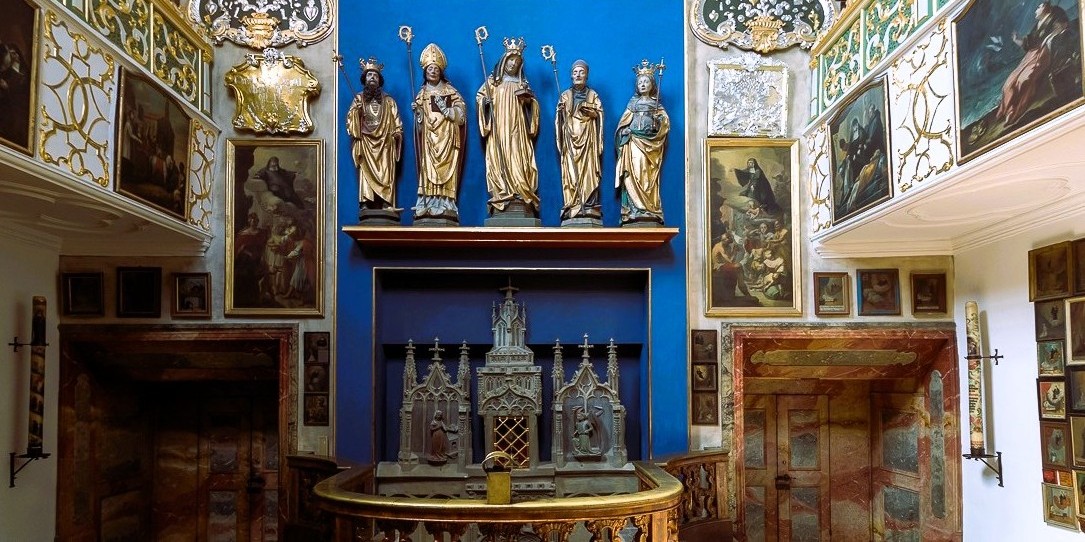
Statues of St. Walburga and her family, and surrounding artwork and mementoes depicting miracles attributed to her intercession / Beneath this is the crypt where St. Walburga’s relics are kept at the Abtei St. Walburg in Eichstätt, Germany
In the words of Mother Maria-Michael Newe, OSB: “What would St. Walburga say to us today? Listen, O daughter, forget your people and your father’s house, and follow the Lamb. Seek God in everything. Persevere with great love. Let God’s compassion flow through you, even to the marrow of your very bones. Let us truly celebrate St. Walburga, this great saint. She will lead us to holiness, if we let her. She knows what it means to leave home and country. She knows what it means to have her loved ones die. She knows what it means to let God’s will reign in her life. She knows what it means to love and live in community. She knows its cost. She knows how to fight evil by love and compassion, by simply doing God’s will. Let us pray for this. Let us pray for that humble love she carried with her. She was a humble woman, and one of great light. Our lives are called to be the same, in different ways — Fresh water that comes out, either through our smile, our kindness, our generosity, our prayers, our life hidden with Christ in God.”
Hymn “Ave flos Virginum” composed by Heribert, Bishop of Eichstatt, 1022-1042
Greetings to you, O Virgin of the Lord, St. Walburga,
Renowned sister of Willibald and Wynnebald,
You who consecrated yourself willingly to Christ.Amidst the throng of holy people,
England, your mother, lovingly nourished you
And sent you to us, angel-like Virgin.And the Mother of the Lord, Mother and Virgin,
Ranks you among the choir of rejoicing virgins,
Consecrates you as the blessed bride of her Son.Behold, the choir of angels bids you welcome
With the call of the Lord, ‘Beloved virgin,
Come to Me into the kingdom of everlasting joy!’To the Triune God creation pays homage;
Virgins, prudent, and proved true, sing Him hymns.
Intercede for us, O Virgin Walburga. Amen.