Tending the Fire of Advent

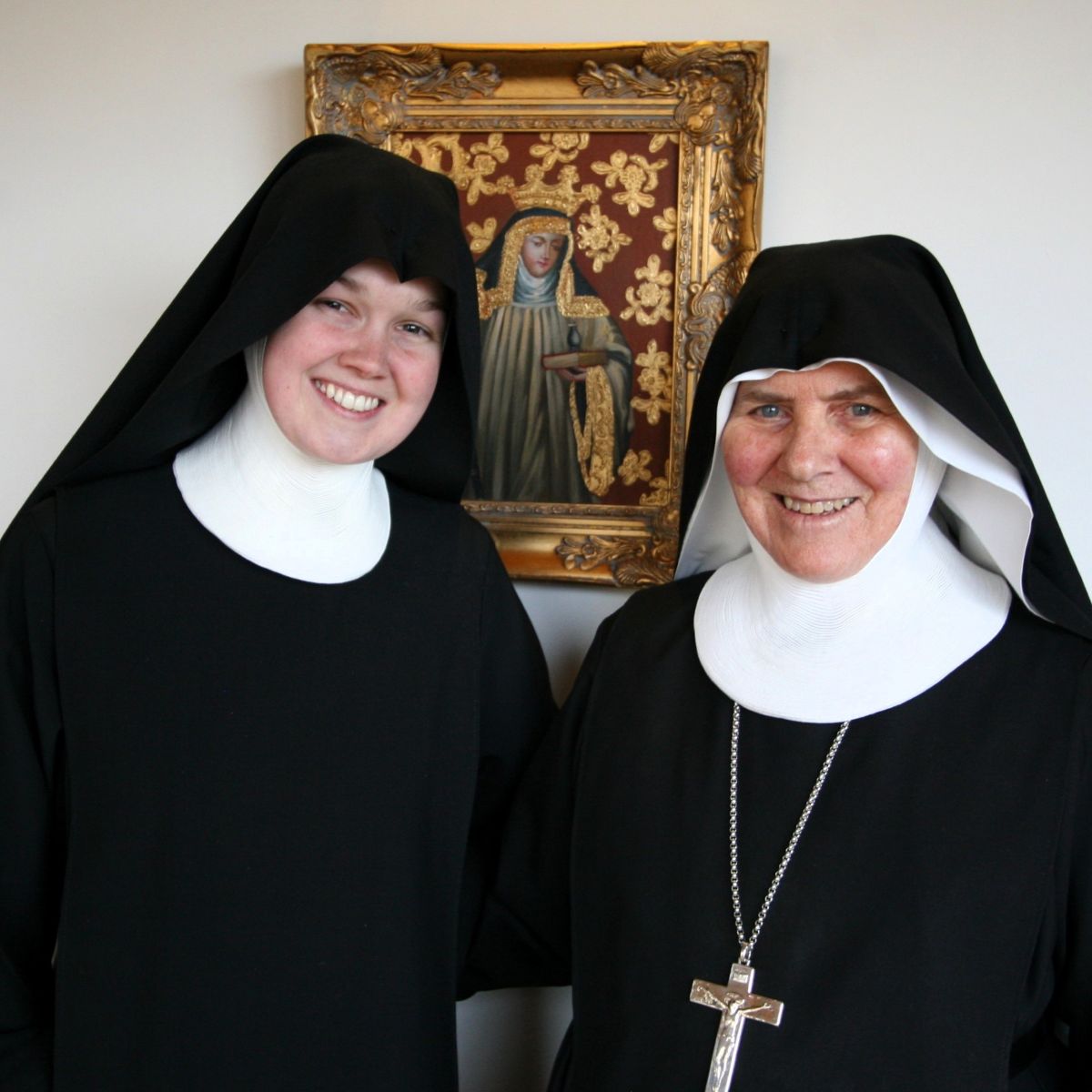
Celebrating Sister Cecilia’s First Profession

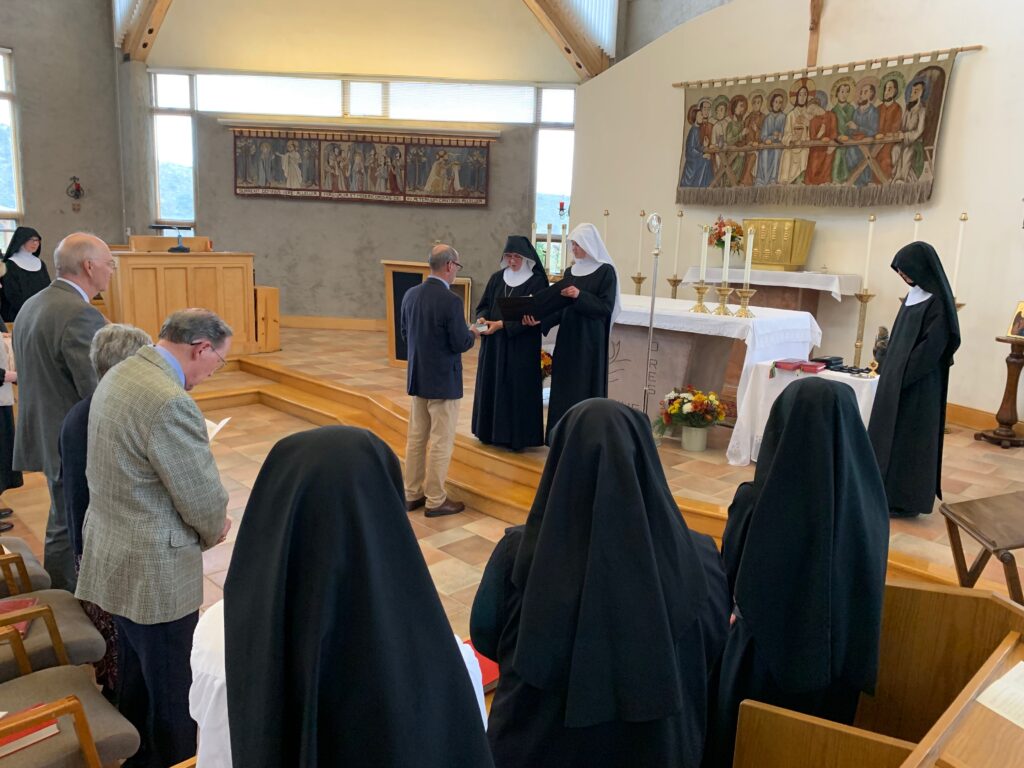
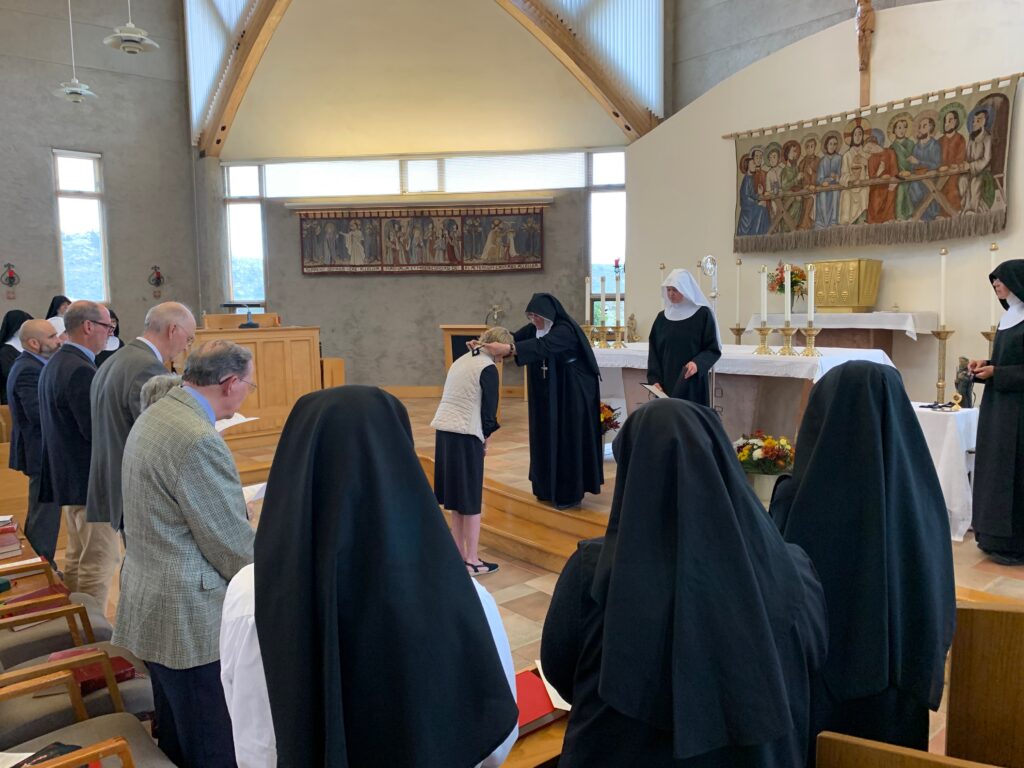
In this season of joyful anticipation, our community celebrated the First Monastic Profession of Sister Clare, who received the name Sister Cecilia on the Solemnity of the Immaculate Conception (December 8, 2025). She professed stability, fidelity, and obedience to the monastic way of life for the next three years, to be renewed annually until Solemn Monastic Profession.

This Advent, we pray that God would enkindle in Sister Cecilia’s heart an ever-growing love for the sweet yoke of Christ according to the Rule of St. Benedict. In that same spirit, Mother Maria-Michael, OSB, delivered an address on November 29, inviting us to keep the Advent flame alive in our hearts with vigilance in prayer and service. Below is an abridged version of her reflection.

Staying vigilant

Advent is really the life of the monk. It is what we are all about: being vigilant and being ready.

In the Divine Office, we read, “Sober, just, and godly we live in this world as we live in blessed hope for the glorious coming of our mighty Savior, Jesus Christ. Let us be concerned with inspiring each other to love and do good works” (Titus 2:12-13). That is a holy community! That is one that is truly seeking God and not self.

Likewise, in today’s Gospel, Jesus offers us a timely exhortation:

Beware that your hearts do not become drowsy
from carousing and drunkenness
and the anxieties of daily life,
and that day catch you by surprise like a trap.
For that day will assault everyone
who lives on the face of the earth.
Be vigilant at all times
and pray that you have the strength
to escape the tribulations that are imminent
and to stand before the Son of Man.

Luke 21:34-36; emphasis added

He does not say that we “become drowsy because we have been working hard.” It is not a surprise that we are tired. It is not a surprise that sometimes we feel a little worn out. We should! We are putting everything into the life we are living. That is the gift we give to God. Sometimes getting up for Matins is hard, but that is the choice of one who is vigilant — one who is waiting for God.

That is the Gospel we should keep before ourselves this Advent. We have to live with vigilance.

The fire of unity

I have been thinking so much about the fire of the early Church — the love with which they lived their lives. They were aflame. They were standing strong, and they were truly one. They loved the Church.

And I pray that we, too, reclaim again that love. We should be like a community keeping the Easter fire going — the Easter fire from the beginning, the first Easter fire that shot fire into the world.

We should keep Advent as precious as the Easter fire. And let us be that fire for the Church. We need to be the sparks that make everything go afire. It only takes a spark to start a forest fire — that is all it takes. But what if we are a torch?
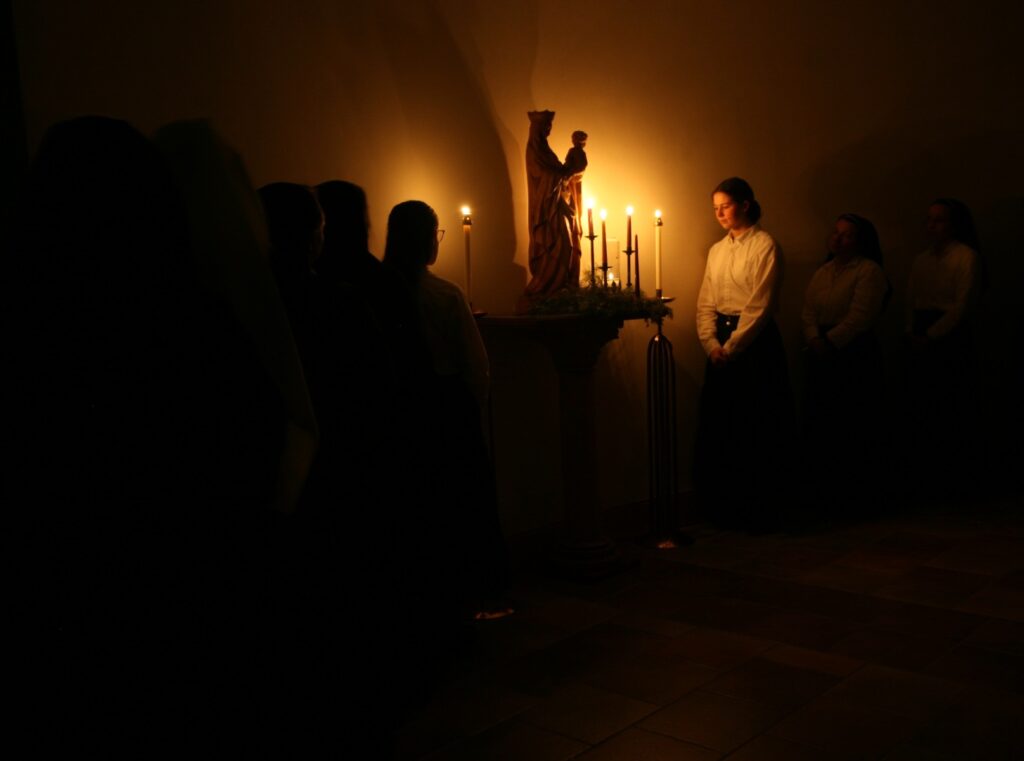
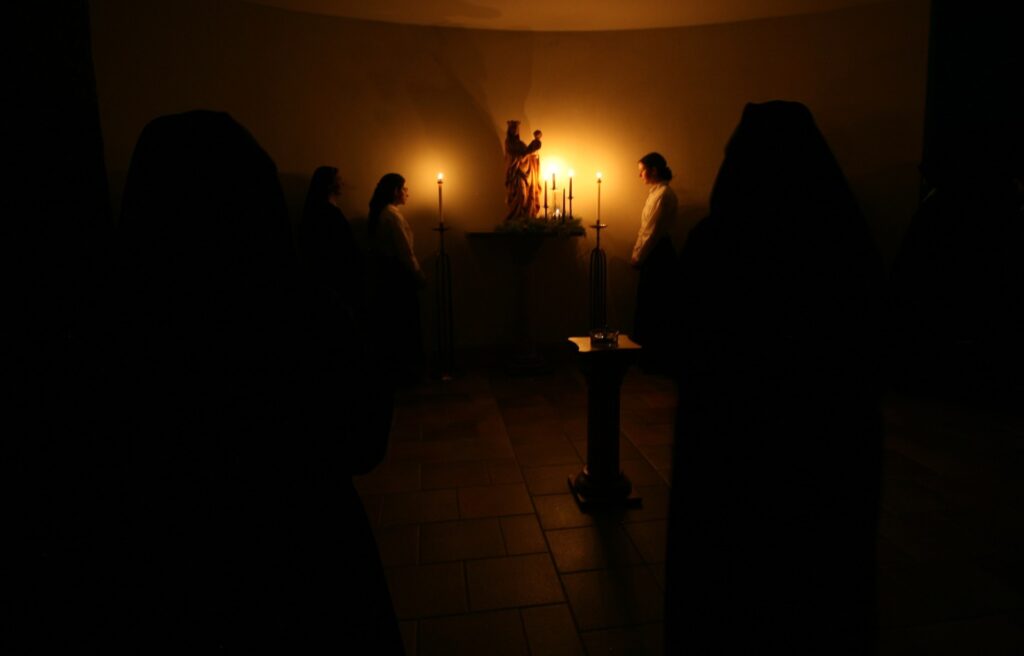
We have to live with great love for the Church.

How relevant this is for our day! We are not called to tear the Church apart. We are called to trust in God, and we are called to unity in obedience to the Church. And I would ask that we pray specifically for the Church this Advent. It does not need to be torn apart — and, quite frankly, a lot of schisms are tearing parishes apart and pulling people away.

That is not the Church.

I think it is going to take a lot of prayer to bring it back. But isn’t that our life? It is one of prayer. It is one of obedience. It is one of sacrifice.

St. Benedict was very clear on this when we hear about the kinds of monks:

Third, there are the sarabaites, the most detestable kind of monks, who with no experience to guide them, no rule to try them ‘as gold is tried in a furnace’ (Prov. 27:21), have a character as soft as lead. Still loyal to the world by their actions, they clearly lie to God by their tonsure. Two or three together, or even alone, without a shepherd, they pen themselves up in their own sheepfolds, not the Lord’s. Their law is what they like to do, whatever strikes their fancy. Anything they believe in and choose, they call holy; anything they dislike, they consider forbidden.

RB 1.6-9

I think we should go back to this chapter and read it again, because it has such great wisdom in it. It shows us what unity means. It shows us how you have to be ever vigilant to be good monks.

Do not be afraid to know what you do wrong. Be afraid that you don’t. And be willing to change it. We must say to ourselves, “No, I am not going that way anymore. Is it not God’s call to bring me to holiness? I must continue on the straighter road. I must continue to strive for holiness.”

If we all strive for holiness this way, we become one in unity — one in community. We strive to live well by inspiring each other to the good things.

Eagerness in prayer

I love going to Matins early every morning and seeing everyone coming. It makes me think, “I’ve got to get in there — I want to be a part of that!” I love when the bell rings and everyone is in a hurry to get to chapel. I think that is such a grace.

I also think it is such a grace when we serve each other at table. That is one of the most beautiful things of the monastic life. The world needs to return to serving one another. We need to keep that strong.

And we need to remember, during this Advent, that we are going to serve each other as best we can and keep our minds on prayer.

Let us dive in with joy. Let us pick up this season and run with hearts open wide. Jesus Christ is the King of Kings and Lord of Lords. When we pray “Your Majesty,” we must remember that He is the most majestic. I pray that everyone will have a holy and spiritually uplifting Advent that leads to prayer in which we are full of gratitude for Him who came so humble that He chose to be a child.

There’s nothing more humble.
“In the Presence of the Angels”: Address to Oblates

A reflection by our Abbess, Mother Maria-Michael Newe, OSB

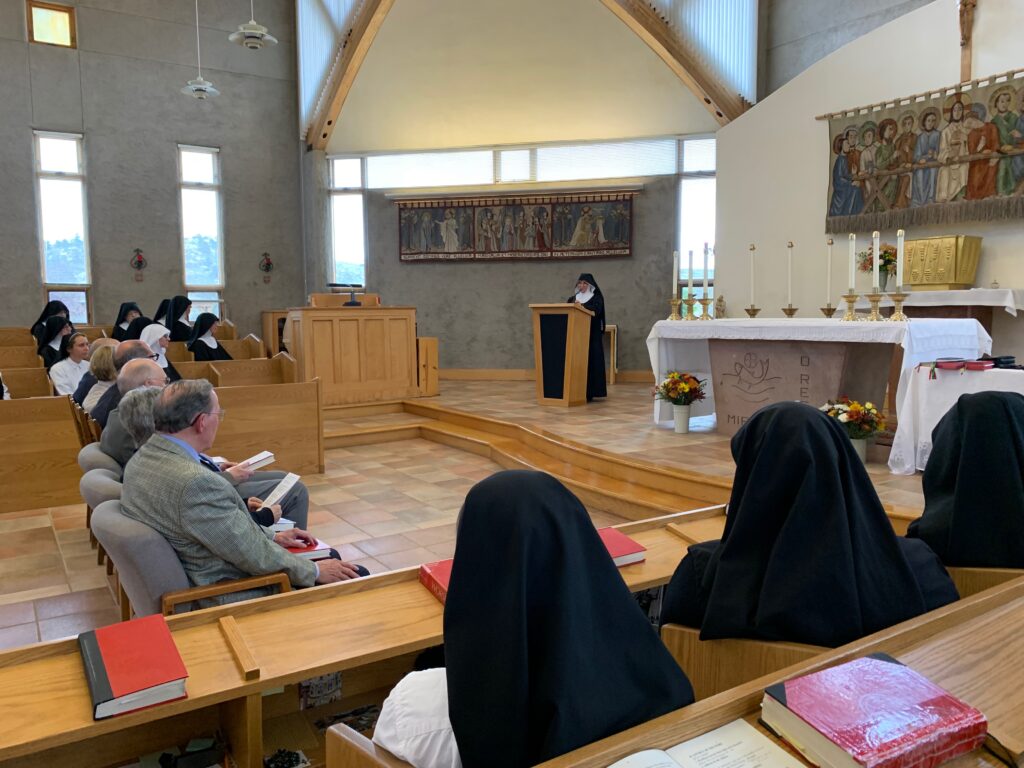
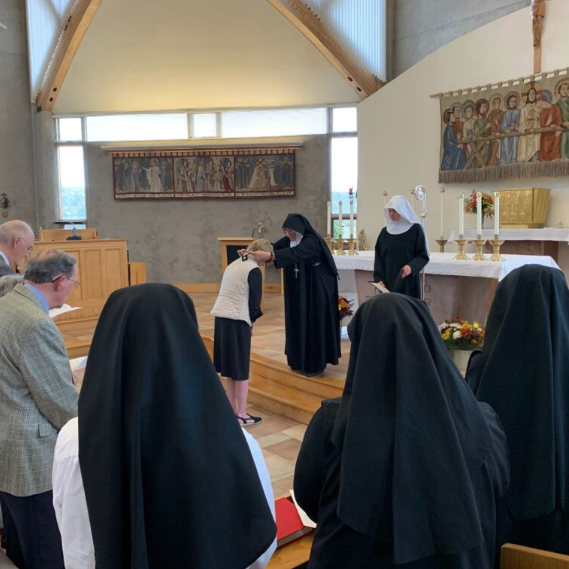
On October 5, 2025, we gathered to celebrate the final oblations of six of our oblates. During the ceremony, Mother Maria-Michael emphasized the steadfast presence of our guardian angels in our prayer, our work, and our lives. Below is an abridged form of her address to the community of oblates and nuns of the Abbey of St. Walburga.

We’re happy to see our oblate novices as they make their transition into becoming oblates. It’s a gift, and we can count on this in so many ways. What I want to remind you of is, in the Rule of St. Benedict, we find stability, conversion of life, and obedience. This creates the boundaries of our lives — to keep us on the straight and narrow path to eternal life with God.

In the last few days, we have celebrated in the liturgy of the Church the feasts of the angels: the Archangels Michael, Gabriel, and Raphael (whom I adore!) on September 29, and the Guardian Angels on October 2. Both of these celebrations have such a flavor of the Benedictine life: the ora et labora (prayer and work).

Seeking His face

If you’re wondering about the ora of the angels, you can find it here! They keep you safe and have you covered, because they love you. Our guardian angels guarantee that we get to Heaven. They were made from their beginning to serve each soul, personally. They watch your every moment. God sends them to keep us in all our ways (cf. Ps. 91:11). By celebrating the Divine Office of these feasts, it was so clear that our Benedictine life is truly meant to mirror the lives of the angels — those pure heavenly spirits to which Jesus refers in the Gospel of Matthew: “See that you do not despise one of these little ones, for I say to you that their angels in heaven always look upon the face of my heavenly Father” (Matt. 18:10). How powerful is that, that the one interceding for you is seeing the face of God which we love. In Psalm 27:8, we read, “Seek his face.” Seek Him. Seek His face in everyone. Seek His face.

I will tell you how important it is to seek God in one another — because, as we know, when we serve God, we serve other people. Remember how important that is to Christ: “Whatever you did for one of these least brothers of mine, you did for me” (Matt. 25:40). And St. Benedict refers to the angels in Chapter 7 on humility. We read how the angels “appear descending and ascending” (Gen. 28:12). “If we want to reach the highest summit of humility… we must set up that latter on which Jacob in a dream saw… Without doubt, this descent and ascent can signify only that we descend by exaltation and ascend by humility. Now the ladder erected is our life on earth, and if we humble our hearts the Lord will raise it to heaven” (RB 7.5-8).

Do not let Heaven slip you by.

Likewise, it is Chapter 19 that tells us how we should say the Divine Office. It tells us how to pray to God. It says, “We believe that the divine presence is everywhere” (RB 19.1). Do you believe that? Do you think God is absent sometimes — that he doesn’t see you?

He does. He sees every moment.

We believe this to be true when we are assisting at the work of God. The Rule continues: “We must always remember, therefore, what the Prophet says: ‘Serve the Lord with fear’ (Ps. 2:11), and… ‘In the presence of the angels I will sing to you’ (Ps. 138:1). Let us consider, then, how we ought to behave in the presence of God and his angels, and let us stand to sing the psalms in such a way that our minds are in harmony with our voices” (RB 19:3-7).

At their final oblation, our oblates receive the Divine Office, uniting their prayers with those of our community, the world, and the angels of Heaven.

Prayer in the presence of the angels

Yes, we sing the Divine Office in the presence of the angels. We sing within Heaven as well. An intimate bond links the earthly world with the celestial world. Above, the angels celebrate a perpetual liturgy, to which is united here below the liturgy of the Church. Supernatural presences surround us.

The Divine Office is intimately connected with the Holy Sacrifice of the Mass. Just as the Mass is continuously offered to God all over the world each day, so also is the Divine Office. At every hour of every day these communal prayers of the Church render glory to God and unite us with the saving work of Jesus Christ for the salvation of the world.

“How To Pray (and Understand) the Liturgy of the Hours”

How important that Divine Office is! And I want to say it because the Church used to pray it in the Middle Ages — not just the religious. It was the whole Church. Now, the Benedictines are at the forefront of this: we are given the Divine Office to pray. We are given Heaven here on earth. What a gift.

Here I have something from a Catholic site: The heavenly liturgy is described as a “mystical bridge that unites the earthly [worship of the Church] with the divine [worship in Heaven]”. It is a celebration that brings the entire union of saints, angels, and the faithful departed who participate in the praise of God. The Catechism of the Catholic Church emphasizes that the liturgy “is an ‘action’ of the whole Christ,” where the faithful are invited to partake in the salvific mystery of Christ (CCC 1136).

I think it’s so important that the Lamb of God is present — that God is present. We’re not just singing to each other. We’re singing to God. And it is due to Him as our creator to praise Him.

The reason we’re speaking about the Mass and the Divine Office because it has that presence. When Catholics celebrate Mass, they’re not merely participating in a ritual, but rather entering into a “foretaste of [the] heavenly liturgy” (Sacrosanctum Concilium 8). This experience is rooted in the fact that the Mass is part of the eternal worship of God, where Christ, the Lamb of God, is present.

There was a specific time, the feast of All Saints, we had a glorious Vespers. It was as if Heaven poured in. As we processed out, I wasn’t sure if Heaven wasn’t here, and we couldn’t just go up. We were so surrounded by Heaven. I could feel the saints, and especially one who had passed away not so long ago. He was present, as if he wanted to say, “I made it! I’m here!” How powerful, that we pray the Divine Office. It is no small thing. What a gift we have received.

Prayer without ceasing

Let us be reminded of the dignity to which we are called: to pray with the angels and saints and so to participate in the heavenly liturgy which never ceases.

Let us remember never to let it cease in our hearts. You are given a piece of Heaven when you are given your book of prayer — a piece of Heaven. Be faithful to pray it. Wherever you are, remember: your guardian angel prays with you, who sees the very face of God. You are praying with the angels. That is the dignity with which we pray the Office.

Let us also mirror the angels as they participate in the heavenly liturgy. Can you imagine the angels saying, “I don’t want to pray today!” That would be abhorrent. But that wouldn’t happen in Heaven. God is ever present. They are ever singing the praise of God. Be sure of it.

We can only imagine the reverence, humility, and purity as the angels stand before the throne of God as your guardians. Remember that: it is with pure reverence and nothing less.

In addition to receiving the Divine Office, oblates are presented with a Benedictine scapular as a constant reminder that they are always clothed with Christ as his witnesses in their words and work.

As St. Benedict writes about reverence in Chapter 20, “Whenever we want to ask some favor of a powerful man, we do it humbly and respectfully… How much more important, then, to lay our petitions before the Lord God of all things with the utmost humility and sincere devotion. We must know that God regards our purity of heart and tears of compunction, not our many words” (RB 20.1-3). The Psalmist says, “My tears have become my bread” (Ps. 42:4).

How do you practice reverence? How do you practice the core of who you are? Reverence is the mark of a Benedictine. The word means “to revere God” — to love and honor God with our whole heart, our whole soul, and our whole strength (cf. Mk. 12:30). May you teach others by your example, what it means to be reverent. May reverence for God transform your lives and our lives. In everything you do, bear reverence to God’s creation.

Remember, when you grow in reverence, your life changes. I wish you the very best, and I wish for you all the graces of this day never to stop being poured out.

I thank you, Lord, with all my heart;
you have heard the words of my mouth.
in the presence of the angels I praise you.

Ps. 138:1

We invite you to join you in prayer for those who made their final oblation this fall, asking St. Benedict and their guardian angels to intercede for them in their continued journey of living our Benedictine spirituality in the world.

Click here to learn more about our oblate program at the Abbey of St. Walburga.