“In the Presence of the Angels”: Address to Oblates

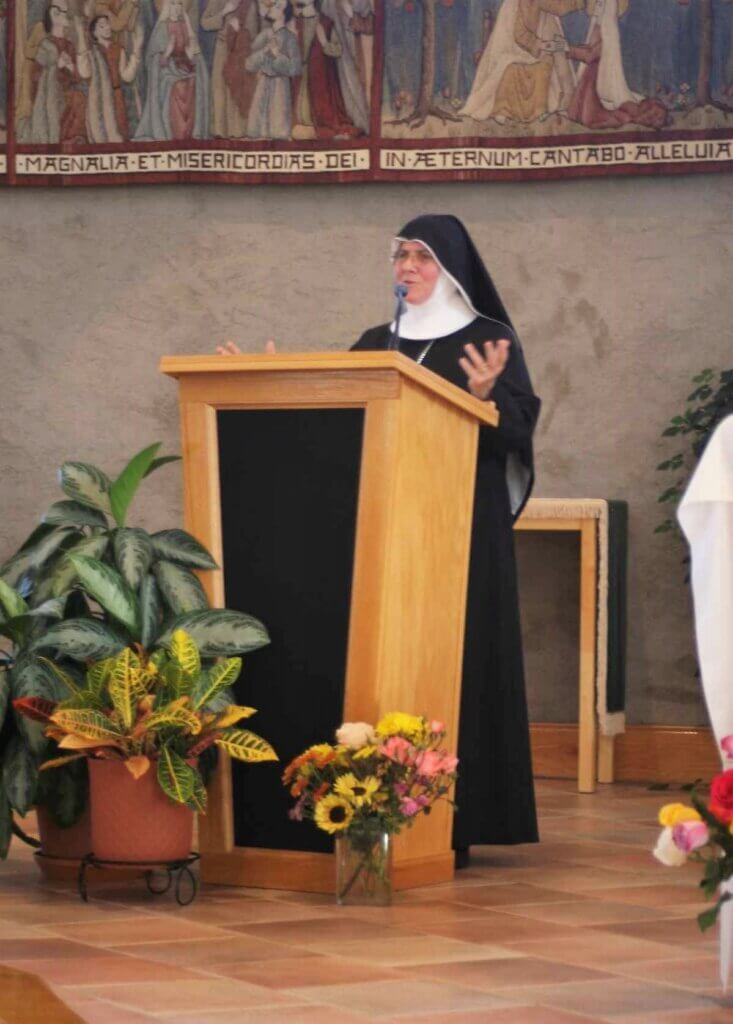
A reflection by our Abbess, Mother Maria-Michael Newe, OSB
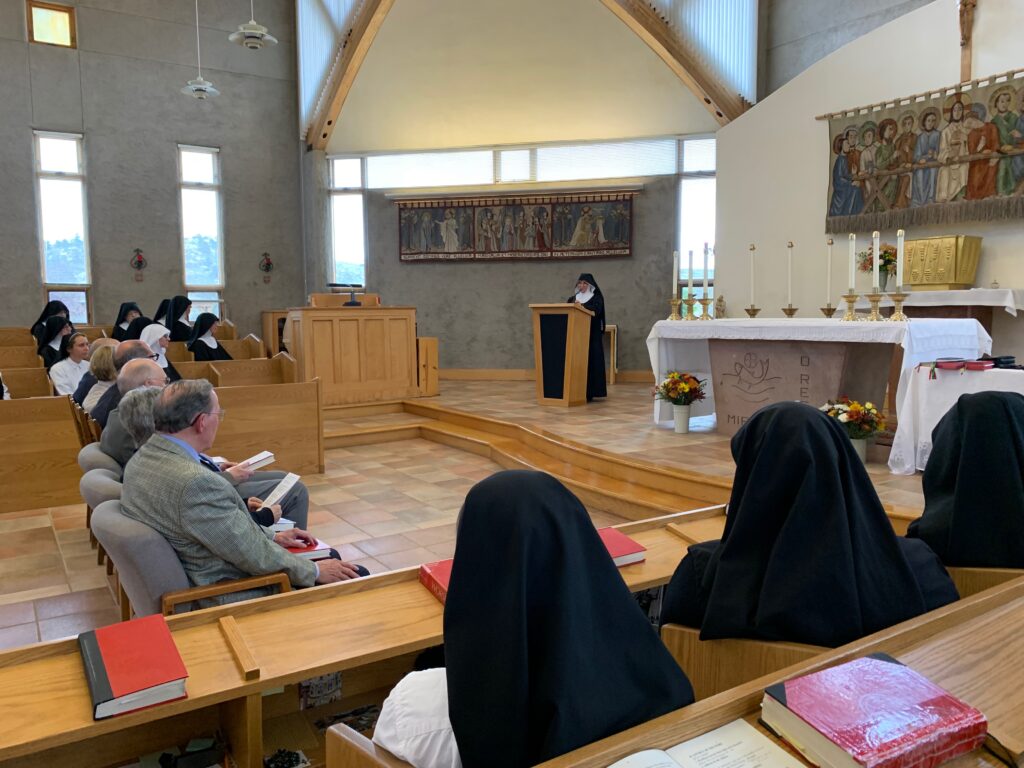
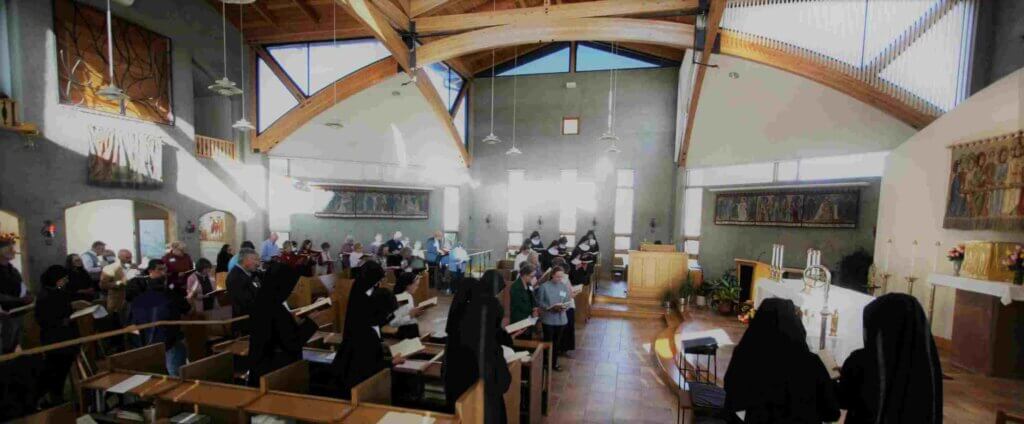
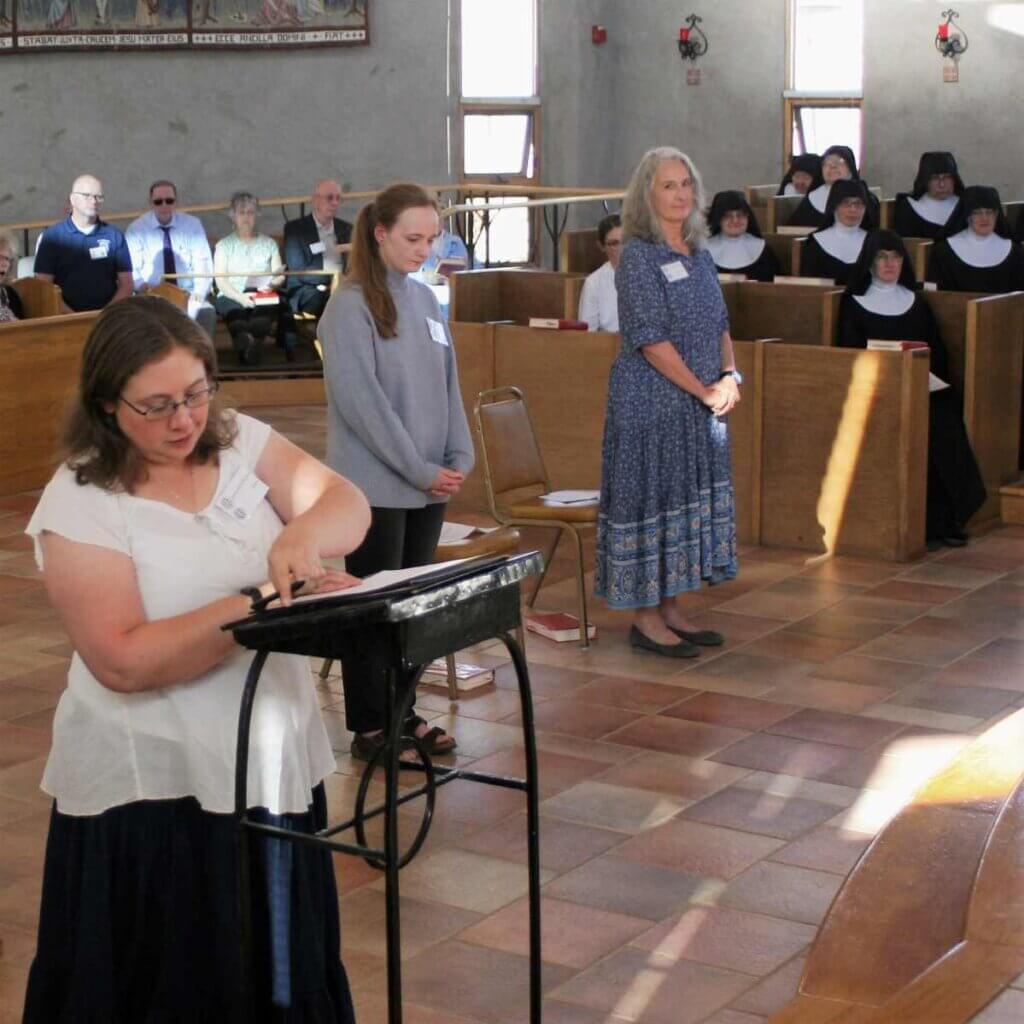
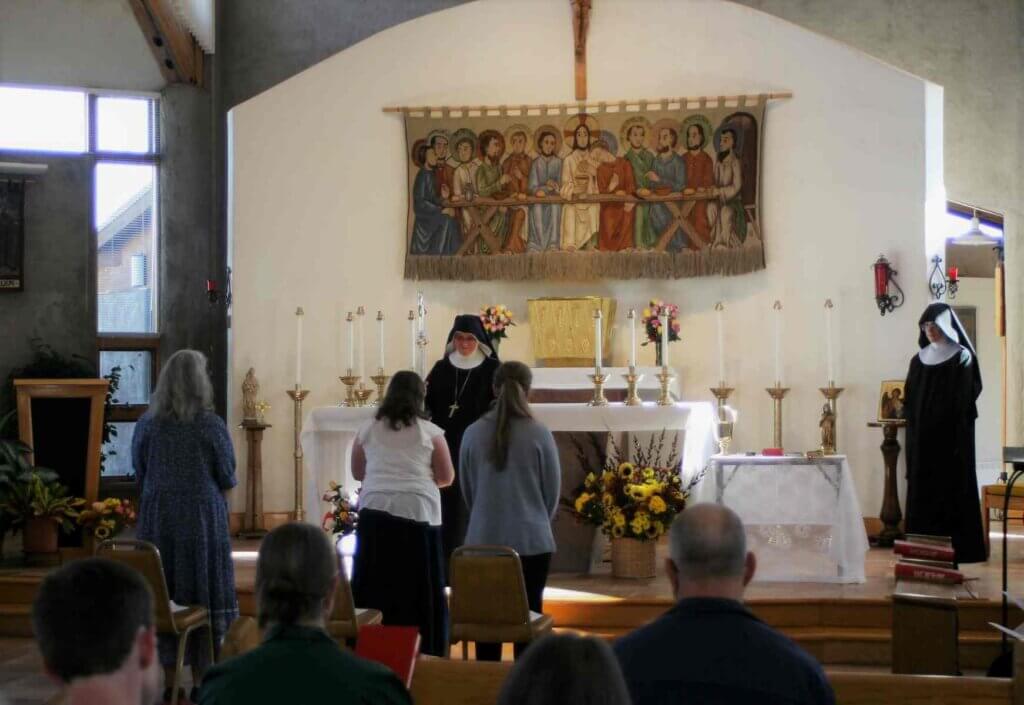
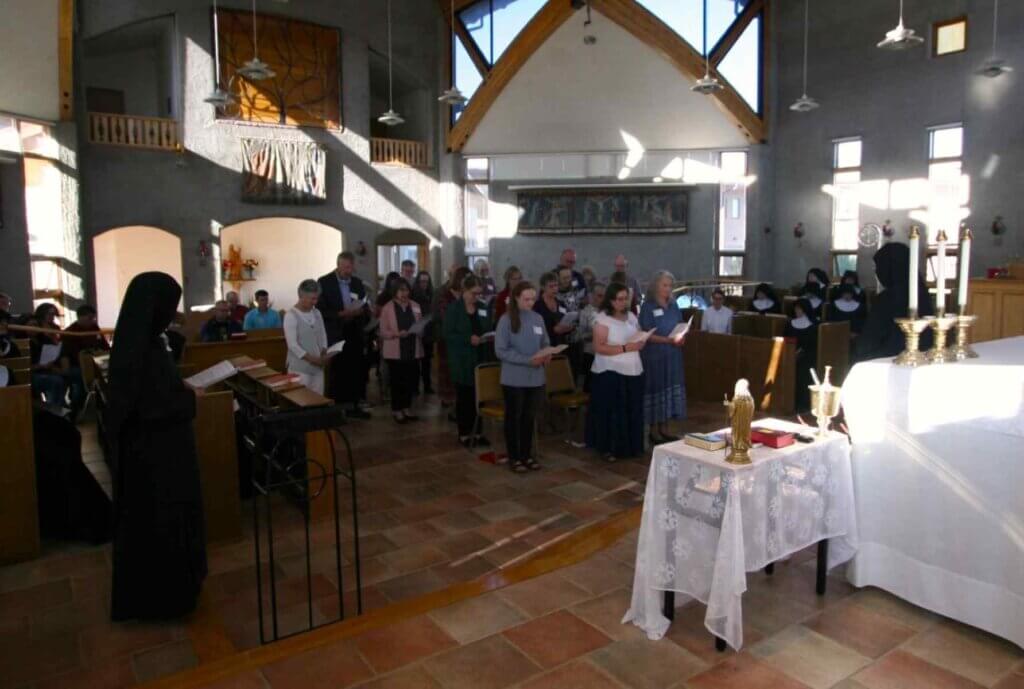
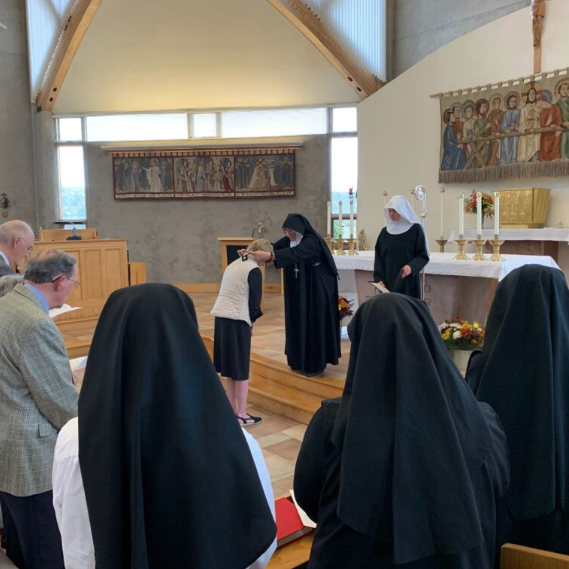
On October 5, 2025, we gathered to celebrate the final oblations of six of our oblates. During the ceremony, Mother Maria-Michael emphasized the steadfast presence of our guardian angels in our prayer, our work, and our lives. Below is an abridged form of her address to the community of oblates and nuns of the Abbey of St. Walburga.

We’re happy to see our oblate novices as they make their transition into becoming oblates. It’s a gift, and we can count on this in so many ways. What I want to remind you of is, in the Rule of St. Benedict, we find stability, conversion of life, and obedience. This creates the boundaries of our lives — to keep us on the straight and narrow path to eternal life with God.

In the last few days, we have celebrated in the liturgy of the Church the feasts of the angels: the Archangels Michael, Gabriel, and Raphael (whom I adore!) on September 29, and the Guardian Angels on October 2. Both of these celebrations have such a flavor of the Benedictine life: the ora et labora (prayer and work).

Seeking His face

If you’re wondering about the ora of the angels, you can find it here! They keep you safe and have you covered, because they love you. Our guardian angels guarantee that we get to Heaven. They were made from their beginning to serve each soul, personally. They watch your every moment. God sends them to keep us in all our ways (cf. Ps. 91:11). By celebrating the Divine Office of these feasts, it was so clear that our Benedictine life is truly meant to mirror the lives of the angels — those pure heavenly spirits to which Jesus refers in the Gospel of Matthew: “See that you do not despise one of these little ones, for I say to you that their angels in heaven always look upon the face of my heavenly Father” (Matt. 18:10). How powerful is that, that the one interceding for you is seeing the face of God which we love. In Psalm 27:8, we read, “Seek his face.” Seek Him. Seek His face in everyone. Seek His face.

I will tell you how important it is to seek God in one another — because, as we know, when we serve God, we serve other people. Remember how important that is to Christ: “Whatever you did for one of these least brothers of mine, you did for me” (Matt. 25:40). And St. Benedict refers to the angels in Chapter 7 on humility. We read how the angels “appear descending and ascending” (Gen. 28:12). “If we want to reach the highest summit of humility… we must set up that latter on which Jacob in a dream saw… Without doubt, this descent and ascent can signify only that we descend by exaltation and ascend by humility. Now the ladder erected is our life on earth, and if we humble our hearts the Lord will raise it to heaven” (RB 7.5-8).

Do not let Heaven slip you by.

Likewise, it is Chapter 19 that tells us how we should say the Divine Office. It tells us how to pray to God. It says, “We believe that the divine presence is everywhere” (RB 19.1). Do you believe that? Do you think God is absent sometimes — that he doesn’t see you?

He does. He sees every moment.

We believe this to be true when we are assisting at the work of God. The Rule continues: “We must always remember, therefore, what the Prophet says: ‘Serve the Lord with fear’ (Ps. 2:11), and… ‘In the presence of the angels I will sing to you’ (Ps. 138:1). Let us consider, then, how we ought to behave in the presence of God and his angels, and let us stand to sing the psalms in such a way that our minds are in harmony with our voices” (RB 19:3-7).
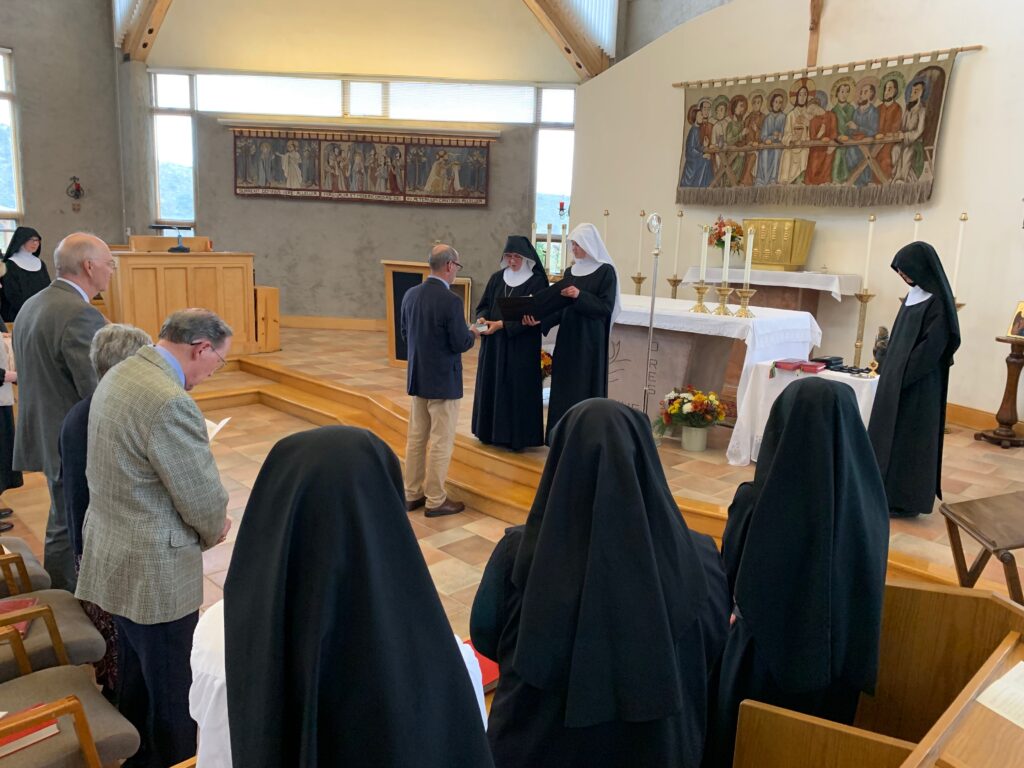
At their final oblation, our oblates receive the Divine Office, uniting their prayers with those of our community, the world, and the angels of Heaven.

Prayer in the presence of the angels

Yes, we sing the Divine Office in the presence of the angels. We sing within Heaven as well. An intimate bond links the earthly world with the celestial world. Above, the angels celebrate a perpetual liturgy, to which is united here below the liturgy of the Church. Supernatural presences surround us.

“The Divine Office is intimately connected with the Holy Sacrifice of the Mass. Just as the Mass is continuously offered to God all over the world each day, so also is the Divine Office. At every hour of every day these communal prayers of the Church render glory to God and unite us with the saving work of Jesus Christ for the salvation of the world.” (“How To Pray (and Understand) the Liturgy of the Hours”)

How important that Divine Office is! And I want to say it because the Church used to pray it in the Middle Ages — not just the religious. It was the whole Church. Now, the Benedictines are at the forefront of this: we are given the Divine Office to pray. We are given Heaven here on earth. What a gift.

Here I have something from a Catholic site: The heavenly liturgy is described as a “mystical bridge that unites the earthly [worship of the Church] with the divine [worship in Heaven]”. It is a celebration that brings the entire union of saints, angels, and the faithful departed who participate in the praise of God. The Catechism of the Catholic Church emphasizes that the liturgy “is an ‘action’ of the whole Christ,” where the faithful are invited to partake in the salvific mystery of Christ (CCC 1136).

I think it’s so important that the Lamb of God is present — that God is present. We’re not just singing to each other. We’re singing to God. And it is due to Him as our creator to praise Him.

The reason we’re speaking about the Mass and the Divine Office because it has that presence. When Catholics celebrate Mass, they’re not merely participating in a ritual, but rather entering into a “foretaste of [the] heavenly liturgy” (Sacrosanctum Concilium 8). This experience is rooted in the fact that the Mass is part of the eternal worship of God, where Christ, the Lamb of God, is present.

There was a specific time, the feast of All Saints, we had a glorious Vespers. It was as if Heaven poured in. As we processed out, I wasn’t sure if Heaven wasn’t here, and we couldn’t just go up. We were so surrounded by Heaven. I could feel the saints, and especially one who had passed away not so long ago. He was present, as if he wanted to say, “I made it! I’m here!” How powerful, that we pray the Divine Office. It is no small thing. What a gift we have received.

Prayer without ceasing

Let us be reminded of the dignity to which we are called: to pray with the angels and saints and so to participate in the heavenly liturgy which never ceases.

Let us remember never to let it cease in our hearts. You are given a piece of Heaven when you are given your book of prayer — a piece of Heaven. Be faithful to pray it. Wherever you are, remember: your guardian angel prays with you, who sees the very face of God. You are praying with the angels. That is the dignity with which we pray the Office.

Let us also mirror the angels as they participate in the heavenly liturgy. Can you imagine the angels saying, “I don’t want to pray today!” That would be abhorrent. But that wouldn’t happen in Heaven. God is ever present. They are ever singing the praise of God. Be sure of it.

We can only imagine the reverence, humility, and purity as the angels stand before the throne of God as your guardians. Remember that: it is with pure reverence and nothing less.
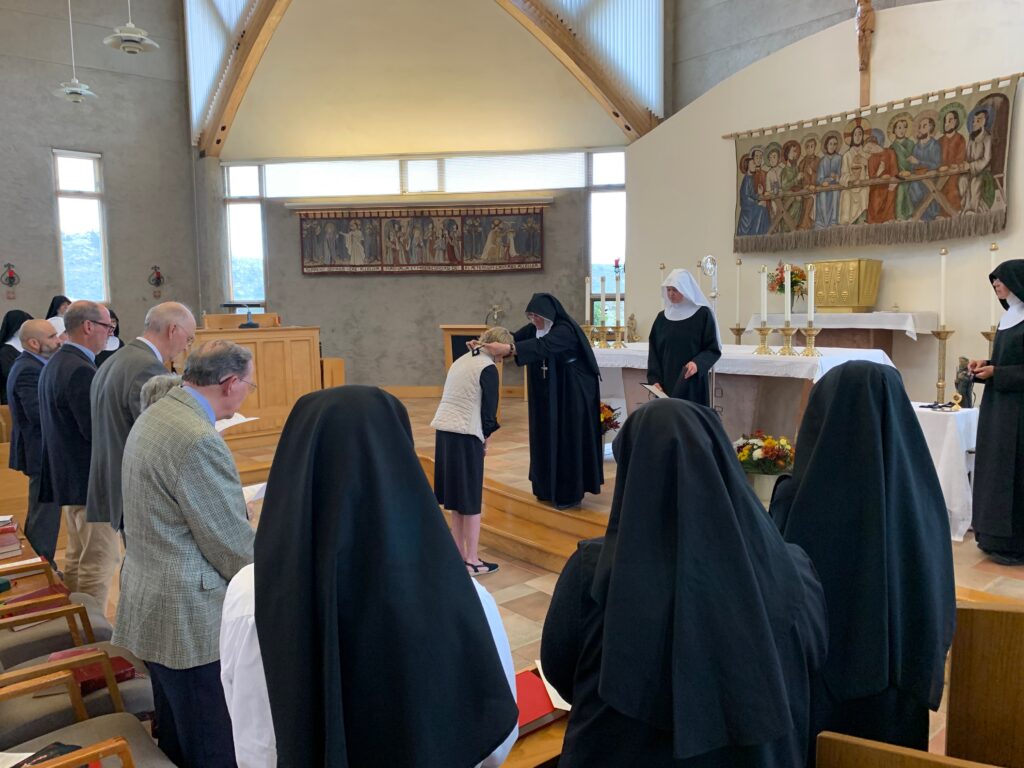
In addition to receiving the Divine Office, oblates are presented with a Benedictine scapular as a constant reminder that they are always clothed with Christ as his witnesses in their words and work.

As St. Benedict writes about reverence in Chapter 20, “Whenever we want to ask some favor of a powerful man, we do it humbly and respectfully… How much more important, then, to lay our petitions before the Lord God of all things with the utmost humility and sincere devotion. We must know that God regards our purity of heart and tears of compunction, not our many words” (RB 20.1-3). The Psalmist says, “My tears have become my bread” (Ps. 42:4).

How do you practice reverence? How do you practice the core of who you are? Reverence is the mark of a Benedictine. The word means “to revere God” — to love and honor God with our whole heart, our whole soul, and our whole strength (cf. Mk. 12:30). May you teach others by your example, what it means to be reverent. May reverence for God transform your lives and our lives. In everything you do, bear reverence to God’s creation.

Remember, when you grow in reverence, your life changes. I wish you the very best, and I wish for you all the graces of this day never to stop being poured out.

“I thank you, Lord, with all my heart;
you have heard the words of my mouth.
in the presence of the angels I praise you.” (Ps. 138:1)

We invite you to join you in prayer for those who made their final oblation this fall, asking St. Benedict and their guardian angels to intercede for them in their continued journey of living our Benedictine spirituality in the world.

Click here to learn more about our oblate program at the Abbey of St. Walburga.

Address to Oblates

On October 8, 2023, we gathered to celebrate the final oblations of three of our oblates.  During the ceremony, Mother Maria-Michael delivered an inspiring address, emphasizing our Benedictine call to stability, obedience, silence, humility and prayer. Below is an abridged form of her address to the community of oblates and nuns of the Abbey of St. Walburga.

I welcome each one of you, and I am so happy for this day, and for our new oblates!  I want to thank all of our oblates for pursuing the Benedictine way.  I thank you because you are living in the world what we are living here, showing a glimpse of our Abbey to those who may never come here.  It is you who bring us out into the world by living the Benedictine spirituality.  That is no small thing!  We are so grateful that you are doing that important work of living in the world amongst God’s people (and they are God’s people, whether they like it or not!) and being a witness to Christ for them. 

What a joy and blessing it is to be united in our love for God and our desire to live lives of holiness by following the precepts of St. Benedict, as given in his Holy Rule.  You notice it’s not just a “rule,” it’s not just a way to be; it’s a holy rule.  It is a way of life hastening us toward our heavenly home by providing us with tools for the cultivation of virtues.  In the Holy Rule of St. Benedict we learn about the great pillars of monastic life, the things that make monastics.  One of these pillars is stability, and by this I do not mean that the vocation of oblates is to live with us in our monastery (we don’t have the room anyway!).  The Holy Rule helps all of us with establishing stability in our lives, stability in the community in which we pray, stability in the Church, and most especially, stability in Christ.  Stability in Christ is not to live in fear and worry about what will happen in the future, or constant regret over the past, but to embrace the sacrament of the present moment.  Really, this is a wonderful mark of a Benedictine: If you wake up in the morning and say, “I get to do this again!”  “I get to do it as I want, as I will…To follow God.”  “I’m not going to hold on to the burdens of what went wrong yesterday; I’m going to wake up fresh, and with the desire for conversion, in order to live this day the best I can.”  Because you never know what day will be your last, so try to live each day well.  That is truly a Benedictine way of being. 

Mother Maria-Michael addresses the oblates making their final vows:
I want to thank you for coming forth to make your final oblation to our Benedictine Abbey of St. Walburga.  Continue to get to know St. Walburga; she is an incredible saint.  She truly loves God and everything He loves, so she has the holy oil flowing from her bones to this day, as she never ceases loving God’s people and interceding for them.  

Another pillar is found in Chapter 5 of the Holy Rule, the chapter on obedience.  “The first step of humility is obedience without delay, which comes naturally to those who prefer nothing to the love of Christ.  Because of the holy service they have professed…they carry out the superior’s order as promptly as if the command came from God himself.”  When you practice obedience in your life, what does it look like?  As an oblate, paying attention to what the Abbess says is important, because it is a bond that unites us.  It also means obeying the Church, reading the Holy Rule and doing the best you can to live it out.  It means obeying your husband, obeying your wife, and not following your own will all the time.  If you’ve been doing something a certain way for a really long time, would you be open to changing it?  When you go about your day, don’t just do things because that’s what you’ve always done – think again why you do it, why you do the things you do, and maybe you will find that there is something that God wants to be perfected.

Then we have the pillar of silence: “I said I would guard my ways lest I should sin with my tongue” (Holy Rule, Ch. 6).  We really should watch our words, because words are a mirror of the heart.  What you say matters.  St. Benedict also says in Chapter 6, “To speak and to teach is the province of the master, whereas that of the disciple is to be silent and listen.”  This is especially true of our time spent in lectio divina (praying with Scripture).  Through this, we receive food of our souls.  On the Twenty-Sixth Thursday in Ordinary Time, we had a reading at Mass from book of Nehemiah that beautifully emphasized the importance of listening to the Word of God.  We read, “The whole people gathered as one in the open pace before the Water Gate, an they called upon Ezra the scribe to bring forth the book of the law of Moses which the Lord prescribed for Israel” (Nehemian 8:1).  I like that word “prescribed,” because it’s like a prescription, a medicine for our souls.  It was what was prescribed by God.  The Scriptures are like medicine for us.  They heal, they enlighten, they show us the way…But we have to be silent and listen.  We have to give time to God to speak.  Nehemiah continues, “He read out of the book from daybreak until midday…and all the people listened attentively to the Book of the Law…Then they bowed down and prostrated themselves before the Lord, their faces to the ground…Then Nehemiah [and Ezra and the Levites] said to all the people: ‘Today is holy to the Lord your God.  Do not be sad, and do not weep’–for all the people were weeping as they heard the words of the law…Then all the people went to eat and drink, to distribute portions and to celebrate with great joy, for they understood the words that had been expounded to them” (Nehemian 8:3, 6, 9, 12).  There you have a wonderful example of lectio divina, because the people listened, they understood, they cried, and they rejoiced.  Sometimes there will be tears with our prayer, but we should never leave the experience without rejoicing, because it is such a gift of God to know and to understand His word to you. It is essential to allow God’s Word to form you, to confirm you, to convict you, and most especially to love you.

Anna-Marie, a niece of one of our Sisters, signs her oblation card

Then we have humility, another one of those great pillars.  One aspect of humility is acknowledging one’s faults.  How often do you say you’re sorry?  It is so important to be able to apologize to people you have hurt and ask their forgiveness.  Another of St. Benedict’s points in his chapter on humility is contentment with one’s circumstances (cf. Holy Rule, Ch. 7).  Are we content with the circumstances we find ourselves in, or do we spend more time complaining about them than we do facing them and asking God to help us understand them?  Do we ask Him what He might be trying to show us through them?  Or if He doesn’t wish to reveal His reasoning to you when you ask, can you live with that, and be content anyway because you trust Him?  St. Benedict talks about not laughing in Chapter 7 as well, and I believe what he means is that kind of boisterous laughter that prevents you from hearing anything else that’s going on.  There is also the laughter that hurts others, which should certainly be avoided.  Laughter should never tear another person down; it is good to have a good time and laugh about happy things, but never to laugh in a way that harms another.

The chapters between 8 and 20 of the Holy Rule are about prayer – private and communal – and I want to emphasize the part about reverence in prayer.  St. Benedict writes, “Whenever we want to ask some favor of a powerful man, we do it humbly and respectfully, for fear of presumption.  How much more important, then, to lay our petitions before the Lord God of all things with the utmost humility and sincere devotion” (Holy Rule, Ch. 20).  I think of how the Old Testament prophets like Daniel prayed for the people by saying, “We have sinned…”  They didn’t point their fingers and blame the people, but they rather included themselves with the people and said, “We have done this…”  Similarly, when we pray for the Church, when we pray for the world (especially when we pray the Divine Office), we too are a part of that Church, a part of that world; and so when we stand before God to pray, we don’t blame others, but pray for them by standing by them and saying, “We have sinned…” “We have done this…” If you pray this way, you will start to see things differently, and it will transform how you pray.  Also regarding prayer, St. Benedict quotes the psalmist saying, “Seven times a day I praise Thee” (Holy Rule, Ch. 16).  I’m not sure if you have seven times a day to pray the Psalter, but you do have seven times in the day when you can say, “My God, I love You.”  How many times do you just stop what you’re doing and acknowledge God’s presence?  That is Benedictine. 

Oblates make their promises to Mother Maria-Michael, OSB

If our Church today could take these simple things, the Benedictine pillars of stability, obedience, silence, humility and prayer, and place them in the core of the Church, do you think it would look different?  Would we hear different things?  Let us assist the Church by embracing these pillars in our own lives.  I offer this challenge to you, as you make your final oblation, and to all of us – the challenge of living the Benedictine virtues of stability, obedience, silence, humility, and prayer.  The sacrifices you will make to live out these precepts of St. Benedict are no small ones, but in faith, we know that, “Never departing from this guidance, then, but faithfully observing his teaching in the monastery until death, we shall through patience share in the sufferings of Christ that we may deserve also to share in his kingdom. Amen” (Holy Rule, Prologue).  This is what I truly wish for you: the Kingdom of God.

Oblates and nuns of the Abbey of St. Walburga sing the “Receive me, O Lord” chant