Take It to Prayer

A reflection on the example of Jesus’ prayer by Mother Maria-Michael Newe, OSB

I love the story about Jesus and his disciples on the stormy sea.  It tells us so much about relationships.  We hear that “they had not understood the incident of the loaves.  On the contrary, their hearts were hardened” (Mark 6:52), and after that Jesus makes them get in the boat.  He doesn’t ask them, he just tells them – maybe because He needed that time to be alone, to work through His human emotions.  He was a human man, so He was probably disappointed and hurt at their hardness of heart.  Who knows what all was going on with their hardened hearts, but it’s reasonable to imagine that Jesus was hurt because of it.  Jesus went up the mountain to pray, and what did prayer do?  I think it helped Him overcome those human emotions, and once again go to the need of His disciples.  He didn’t pass by when He heard their cries…He answered them, and He got into the boat with them (Mark 6:51). 

Sometimes we have to realize that it is only with prayer can we get through it all, especially in relationships.  Naturally we will be disappointed, naturally we will be hurt, and naturally there will be times when we’re left wondering, “How did that happen?  How was I so misunderstood?”  And then you go and pray about it.  God will help you overcome those human emotions and rise above them, so that you can still act in a Godly way.  It’s such a temptation to run off quickly and tell somebody about our unjust situation.  Instead, try to stop and pray first.  You may still end up telling somebody about it, but after some time in prayer it won’t be quite so harsh.

Prayer is always the best way to start, because Jesus will show you how to overcome the temptation to anger.  Jesus had a just anger in this situation, but that’s not where the story ended.  It’s so important to look at the ending.  He got in the boat with them and calmed the sea.  You can go to Jesus – He’s been through it all.  He truly understands, and shows us His compassionate heart.  Never, never stop praying.
Confession: Coming to the Light

A reflection on John 3:16-21, the Gospel reading for the second Wednesday in Easter by Mother Maria-Michael Newe, OSB

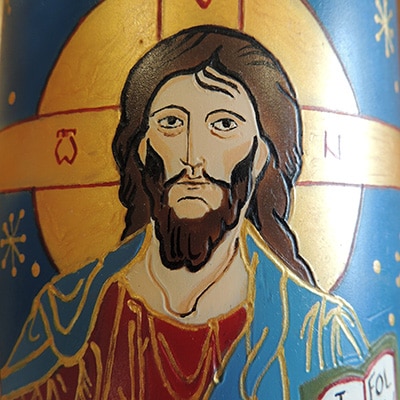
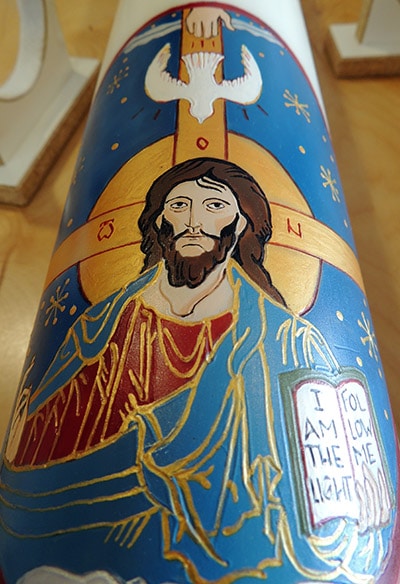
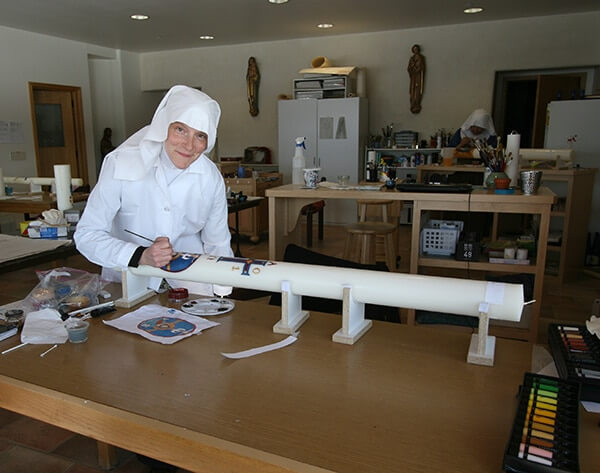
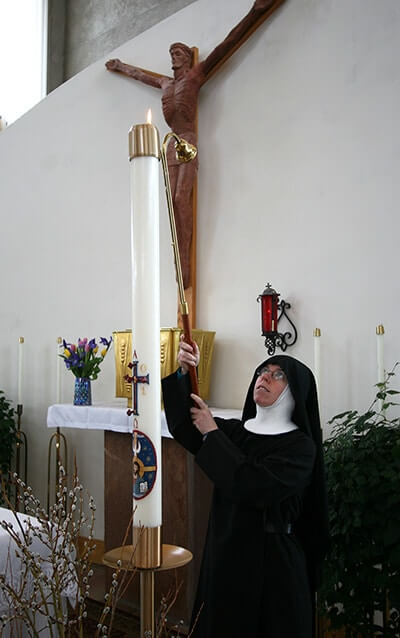
One of our hand-painted 2021 Paschal Candles

“And this is the verdict, that the light came into the world, but people preferred darkness to light, because their works were evil. For everyone who does wicked things hates the light and does not come toward the light, so that his works might not be exposed.”

John 3:19-20

The theme of “coming to the light” gives us a great image of what will happen when we die.  If we are free when we die, we will go to the light quickly, without any problem, especially if all our sins have been confessed and everything has been brought into the light, because then there are no hidden corners, and so we are not afraid of the light.  I think that if we don’t bring things to the light, evil fills us with shame before God, and it’s shame that makes us want to hide from God.  Excessive shame shouldn’t be a part of our lives, because He died for us: “God so loved the world that he gave his only-begotten Son, so that everyone who believes in him might not perish but might have eternal life” (John 3:26).  It’s good to feel shame when we sin, but we should never let our sin make us fear the light.   Never.  Because it is God Himself calling us to the light.  Whatever evil tries to make us feel so ashamed of, we should run to bring it all the more to Christ’s feet… and all the faster.   When we place our sins at His feet in Confession, they are gone.  Therefore we need the grace of light, so that we can bring everything to the light.  What’s funny is that when you bring something shameful to the light it shatters its power.  The light shatters it – it has no power!  So let us do this with great joy, especially during this Easter season.

“And so I say to you, you are Peter, and upon this rock I will build my church, and the gates of the netherworld shall not prevail against it. I will give you the keys to the kingdom of heaven. Whatever you bind on earth shall be bound in heaven; and whatever you loose on earth shall be loosed in heaven.”

Matthew 16:18-19

Living Well in Community

A reflection by Mother Maria-Michael Newe, OSB

I think that, this year, it would be very fruitful for us to focus on community life.  In this year of St. Joseph, we remember that the Holy Family lived in community, and I’m sure it wasn’t always ‘just peachy’ for them.   Saints don’t become saints because everything is easy and there is nothing to try them.   They are going to be tried.  We are going to be tried.  And sometimes we fail because something pushes us a little too hard, and we’re weak, so we fall – but then we need to get up again!  I don’t always understand why people act a certain way, but it’s important that I pray about it and at least question the way in which I’m acting.  We should all be humble enough to ask, “Where do I need to grow in this?  What do I need to do differently?”  Without this self-knowledge, it will be very difficult to be humble, because it’s always going to be somebody else’s fault.  It is the tensions of living in community that enable us to change into something better.   Ask the Lord to show you where there is room for improvement, and be prepared to do it.

So of course there are the hardships of community life, but we also know of the blessings.  How many times have we walked into a meal that we’ve had nothing to do with?  But somebody’s worked hard on it, and we just get to enjoy it.   We walk around the Abbey and find everything tidy and clean, and it may not be an area we have anything to do with. (I should also note the Sisters who are designated to work in the gardens, wash the eggs, deal with our finances, handle maintenance issues, make cheese, and so much more, for the benefit of us all.)  And the greatest gift of community life is that we have the time to pray.  If we didn’t have our Rule, which orders our days so that our minds can be free of always wondering what we should do next, and if we didn’t all live together and help each other, none of us would be in the chapel as much as we are.  Nor would we be able to celebrate the liturgy so beautifully.  Our voices in choir complement each other so well, we have organists, and wonderful readers – God has truly blessed us abundantly.  We have so much to be grateful for, and it is up to each of us to take the steps necessary to live well in community – to cherish charity, not only to do it, but to cherish it, and truly be grateful for one another.

Visit the following pages to see how others are incorporating the blessing of community life into their own lives:

Alleluia Community (our Sister Marie Therese was raised in the Alleluia community, and her father is one of the Elders)

Companions of Christ, Denver (for diocesan clerics)

The Benedict Option

Families of Nazareth

Communion and Liberation

Opus Dei

Madonna House

Catholic Worker Movement

St. Benedict: A Man of Life

One of our Sisters shares an experience she had before entering our community which gave her a foretaste of her future life as a Benedictine nun, though she did not know it at the time:

I was finishing up a day’s work at the hospital when the word was passed around the nurse’s station: “Rachel is going to go home on hospice this week.”  The news wasn’t surprising; Rachel, one of our dear patients in her late teens, had spent a lot of time on our floor over the last couple of years, and her medical condition had gotten much worse recently.  After I completed my shift, I walked down the hall and knocked on Rachel’s door.  I wasn’t in such a peppy mood myself that autumn.  The gentleman I had been dating had unexpectedly broken up with me a few months before, and I found myself unable to leave behind the deep sadness I was still feeling.  But that night I knew I had to say goodbye to Rachel and thank her for the gift she had been to me.  As I sat on her bed, she told me how sad she was to be dying.  I was sad with her.

As I drove home from work that night, I realized with a sudden insight that I was ALIVE, and I was filled with awe and gratitude at this awareness.  By the time I stepped inside my house, I was so overwhelmed with joy at being alive that I began to write down all the things that made me grateful for my life.  Memories and desires poured out almost faster that I could write them down.  I was so overcome with joy for the gift of my own life that the sadness that had been oppressing me for the last few months was suddenly insignificant.  I was alive!!!

My vocational call didn’t come until several years later, but the grace I received from Rachel that night was a foreshadowing of the grace I receive now in my vocation as a Benedictine nun.  The immense gratitude for the gift of my life demands a response, and my response is the complete gift of my life back to my Creator in a sacrifice of praise!  In fact, for me personally, this is not only one way, but the fullest way possible I can express my gratitude to God for creating me.

St. Benedict’s only goal is to seek God, so that we might begin now what will be brought to completion in heaven.  Using the words of St. John, he urges his monks to “run while you have the light of life that the darkness of death may not overtake you” (Rule of St. Benedict, Prologue.13).  No wonder St. Benedict directs even the most ordinary aspects of daily life so carefully.  All those short moments together make up this great gift we have called LIFE, and there is no time to waste in complacency.  I believe that the profound reverence and intentionality with which St. Benedict treats of those smallest choices reveals his deeply grateful heart.

The final verse of Psalm 150, which we sing at Lauds every Saturday and Feast day concludes, “Let everything that breathes, praise the Lord,” and I often note with gratitude that I am indeed still breathing, and I remember Rachel as we sing it.  Thank you, Rachel, for bringing me into such a full life by your death!  I pray that when I follow you into eternity someday, together in the heavenly kingdom we will praise the Lord forever.

Our Newly Professed: Sister Maria-Benedicta, O.S.B.

Sister Maria-Benedicta (previously our “Sister Molly”) made her simple vows on February 10, the Solemnity of St. Scholastica,  It was a joyful occasion that her whole family was able to join us for her profession—including so many adorable nieces and nephews! 

Sister Maria-Benedicta O’Brien is the daughter of Patrick and Jean O’Brien of Denver, and the third of five siblings. Her many gifts and gracious flexibility are a blessing to our community.

Praying as the Bride of Christ

A reflection by Mother Maria-Michael Newe, OSB

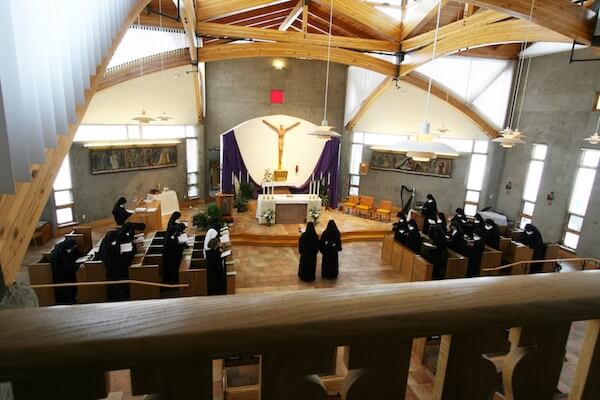
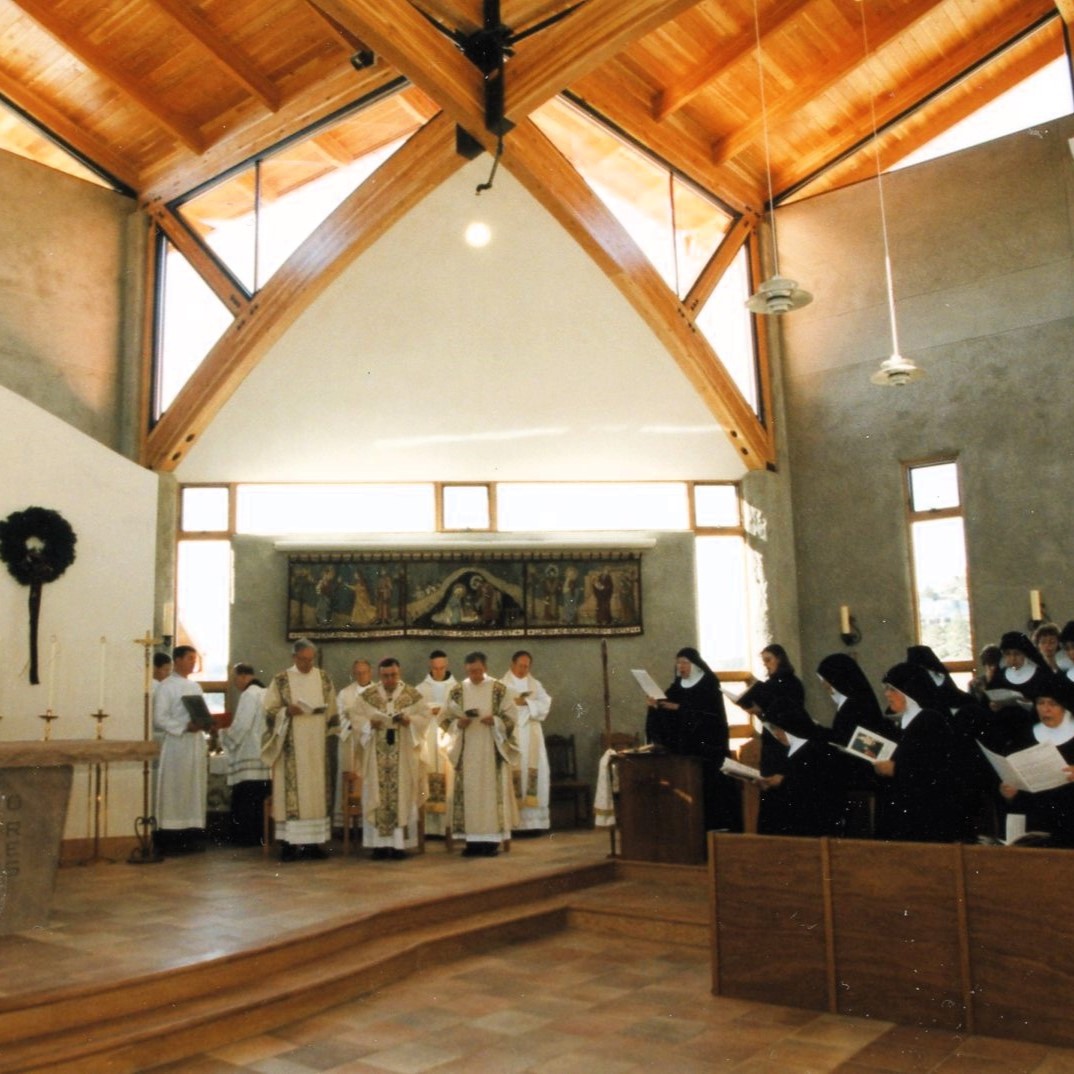
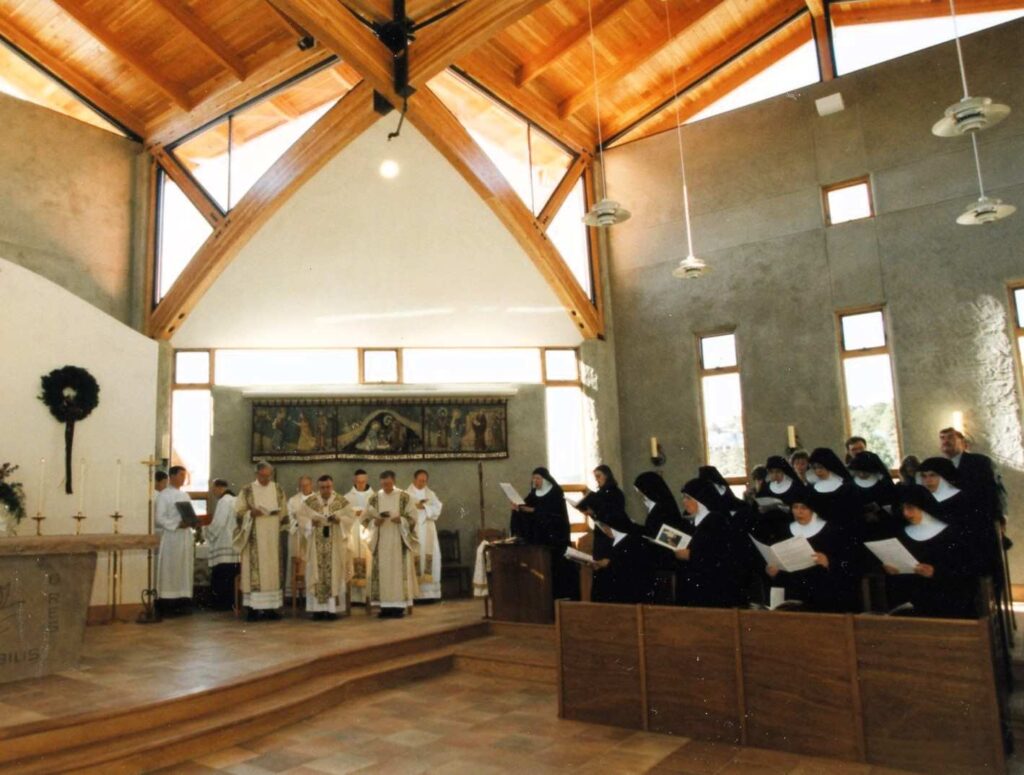
The dedication of our Abbey Church in 1999

As Benedictines, our lives are hidden with Christ in God and, truly, we take on the heart of Christ in prayer. And that is our life — we are called to pray with the heart of Christ.  We hear in the Rule of St. Benedict how we should pray the Divine Office: “We believe that the divine presence is everywhere and ‘that in every place the eyes of the Lord are watching the good and the wicked’ (Prov. 15:3). But beyond the least doubt we should believe this to be especially true when we celebrate the divine office” (RB 19.1-2).

We are not alone when we pray.

St. Benedict continues: “We must always remember, therefore, what the Prophet says: ‘Serve the Lord with fear’ (Ps. 2:11), and again, ‘Sing praise wisely’ (Ps. 46:8); and, ‘In the presence of the angels I will sing to you’ (Ps. 137:1)” (RB 19:3-5).

So who are we assisting at praise?  “In the presence of the angels I will sing to you” (Ps. 137:1).

“Let us consider, then, how we ought to behave in the presence of God and his angels, and let us stand to sing the psalms in such a way that our minds are in harmony with our voices” (RB 19.6-7).

What we sing we must believe.  What we believe we must live out.  We must live out the prayers we pray.

We are the bride of Christ.  We have been born from his side. It is said that, at the end of time, hearts will grow cold.  Let it not be said of us. We are not called just to pray with the mind. If Christ found no consolers, let he at least find consolers among us. And thank him for what he’s done.

Let us be guardians of the heart of Christ.  Let us bear his heart within. That we may be truly one with him in mind and heart so that when we die, we have died with the heart of Christ.  So too shall we rise with his heart.